
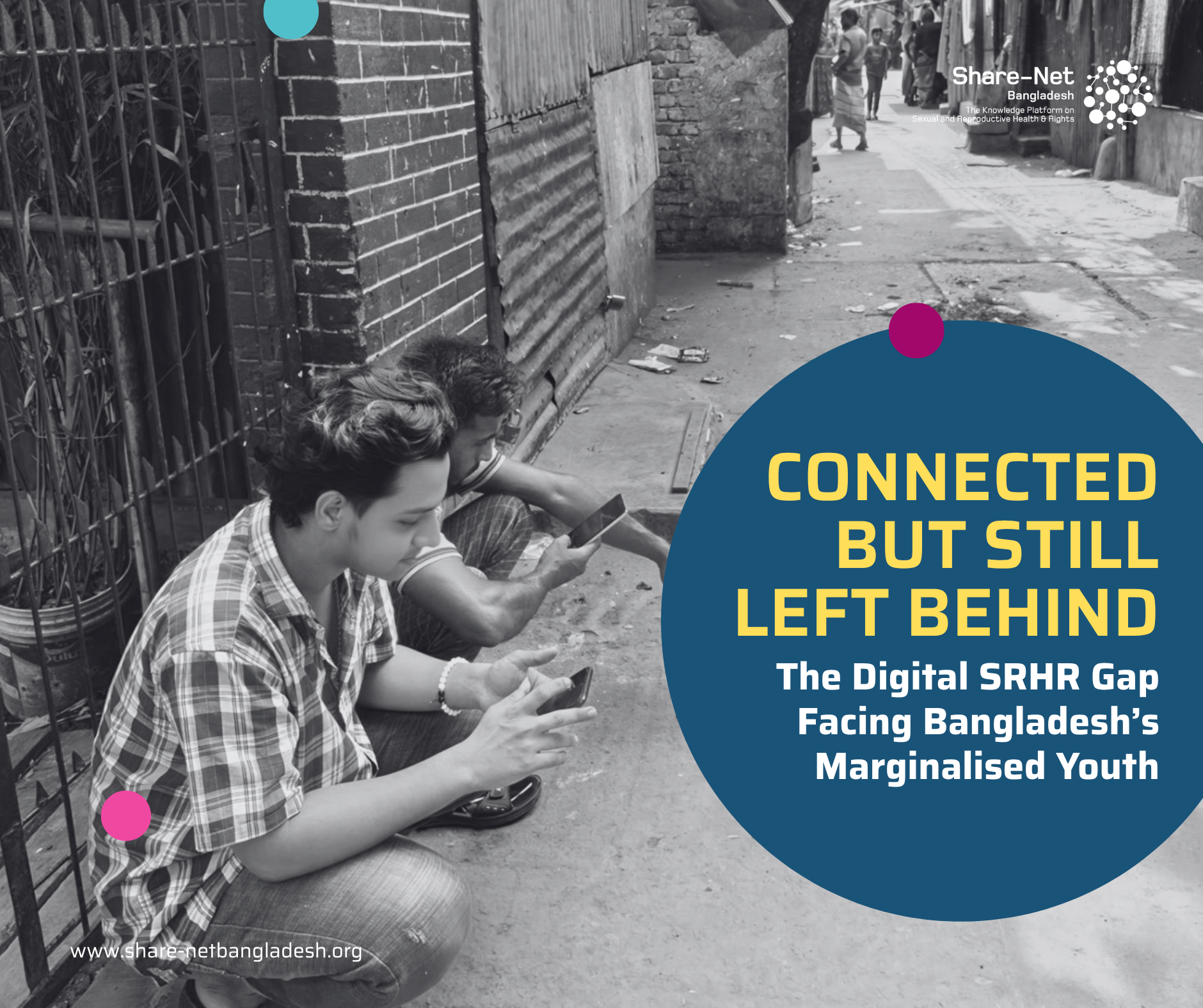
Connected but Still Left Behind: The Digital SRHR Gap Facing Bangladesh’s Marginalised Youth
A young person with a question about puberty, contraception or relationships no longer necessarily waits for a classroom lesson or a health worker. The answer may be only a few taps away. But for a young person living in an informal settlement, sharing a phone, working long hours or searching privately in Banglish, that apparent access can be misleading.
Bangladesh’s digital expansion has been remarkable. BTRC recorded 113.50 million mobile internet subscriptions in February 2026, alongside 14.77 million ISP and PSTN internet subscriptions. Yet a growing digital population does not automatically create equal access to health knowledge. The early findings from the Together Project 2.0 point to a more uncomfortable question: who is actually being served by the digital SRHR ecosystem?
The research team’s consultations with young people, Youth Advisory Board members and communities suggest that marginalised youth often search using the language they actually speak, including Banglish. Yet much of the formal SRHR content they encounter is written in institutional or medical language. The result is a gap between what institutions publish and what young people actually seek.
The problem is also one of trust. Participants reportedly found individual doctors and independent creators more visible in searches than formal health resources. That does not automatically make independent content unreliable, but it creates a credibility challenge when users have limited tools for distinguishing evidence-based advice from misinformation.
This concern is not unique to SRHR. A 2025 UNICEF Bangladesh U-Report poll of almost 29,000 young people found that two-thirds identified fake news and misinformation as the biggest source of stress on social media.
There is another important lesson. The content young people need extends well beyond menstruation, puberty and pregnancy. WHO’s current guidance on comprehensive sexuality education includes relationships, consent, bodily autonomy, contraception, pregnancy, STIs and HIV, while stressing that information should be scientifically accurate, age-appropriate and culturally relevant.
That makes co-creation more than a communications strategy. It is an equity issue.
As the research insight puts it, “This is not a failure of youth. It is a failure of systems that were not designed to serve them.”
Still, the findings should be read carefully. The consultations described in the research are valuable for understanding experiences and identifying patterns, but they do not by themselves establish how all Bangladeshi youth search for SRHR information.
The bigger policy challenge is therefore not simply to produce more digital content. It is to make content findable, understandable, trusted and connected to real services.
Bangladesh’s digital future will be measured not only by how many young people can connect, but by whether the young people furthest from opportunity can find information that respects their reality.
The real question is no longer, “Are young people online?” It is: “When they go online with an important health question, will the system be ready to answer them?”
Brief About the Original Study
Together Project 2.0 is a multi-country research initiative examining access to sexual and reproductive health and rights (SRHR) information among marginalised communities in Bangladesh and Uganda. In Bangladesh, the research explores how young people navigate digital spaces to find SRHR information, with particular attention to relevance, trust, language, privacy and accessibility. Early insights draw on stakeholder consultations, Youth Advisory Board discussions and community engagement sessions. The Bangladesh research is led by Bachera Aktar of BRAC James P. Grant School of Public Health, BRAC University, alongside Patrick Ojok of Gulu Disabled Persons’ Union, Uganda, and Muriel Mac-Seing of the University of Montreal, Canada.