
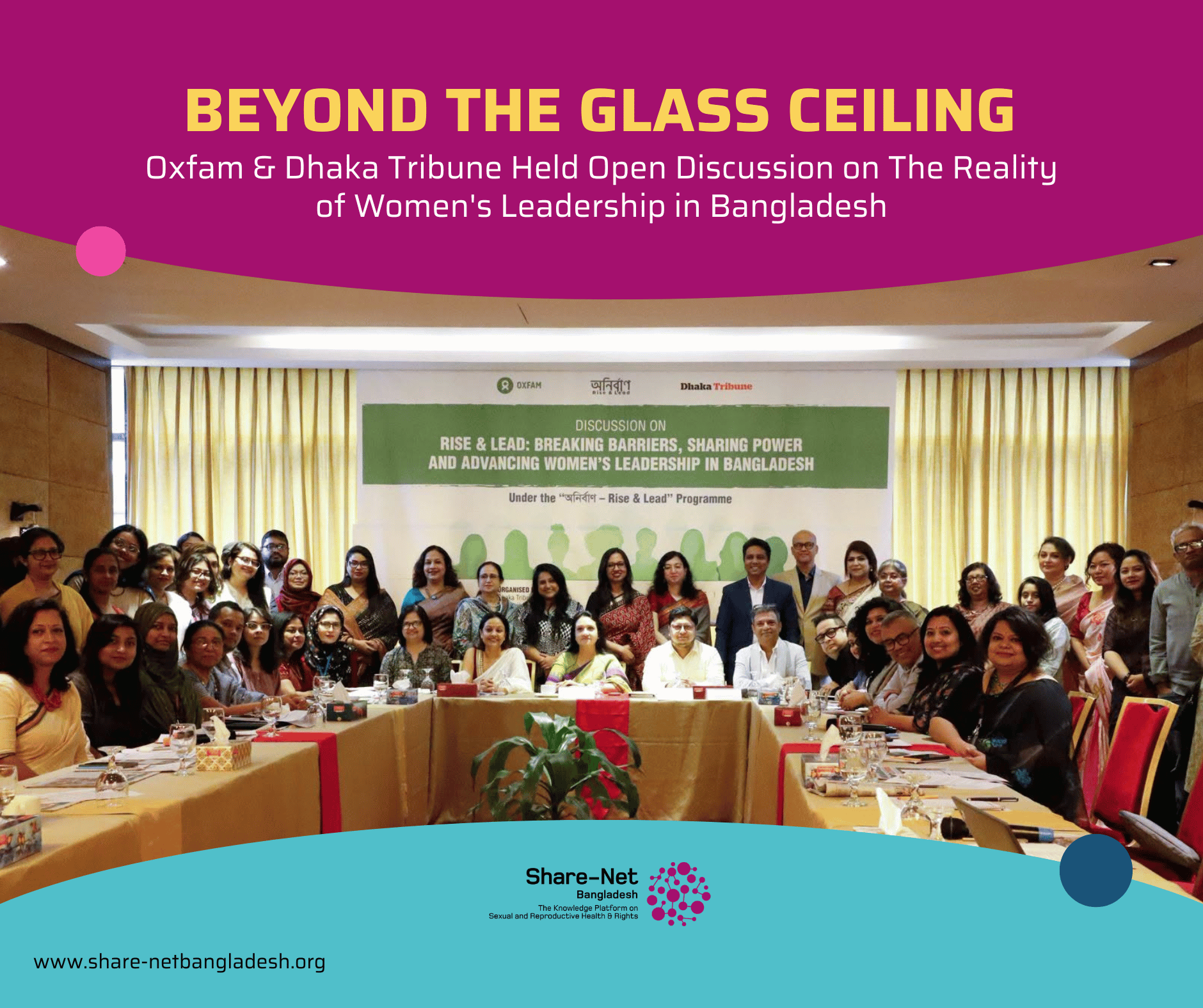
Beyond the Glass Ceiling: Oxfam & Dhaka Tribune Held Open Discussion on the Reality of Women’s Leadership in Bangladesh
Bangladesh has often been praised for improving girls’ education, reducing maternal mortality, and expanding women’s participation in the workforce. Women today are doctors, entrepreneurs, researchers, civil servants and business leaders. Yet when it comes to boardrooms, executive offices and policy tables, their numbers drop sharply. The question is no longer whether women are capable of leading. The real question is whether institutions are prepared to share power.
That question shaped the discussion at “Rise & Lead: Breaking Barriers, Sharing Power and Advancing Women’s Leadership in Bangladesh,” a roundtable jointly organised by Oxfam in Bangladesh and Dhaka Tribune under the Onirban Rise & Lead programme. Bringing together policymakers, academics, development professionals and business leaders, the event explored why leadership remains one of the country’s most persistent gender gaps despite decades of social progress.
The conversation moved beyond celebrating success stories. Instead, participants examined the structural realities that continue to hold women back. “Leadership is not a position or title. It is a state of mind,” said State Minister for Women and Children Affairs and Social Welfare Barrister Farzana Sharmin Putul, arguing that changing laws alone will not transform unequal workplaces without changing social attitudes.
The findings presented during the event painted a familiar but uncomfortable picture. According to World Bank 2025 ILO modelled estimates, women’s labour force participation stands at 38.6 percent, compared with 80.4 percent for men. Bangladesh’s Labour Force Survey 2022 reports a slightly higher female participation rate of 42.8 percent, yet women remain significantly underrepresented in leadership positions.
Perhaps more revealing is where women work. Around 96.6 percent of employed women are engaged in the informal economy, where career progression, workplace protection and leadership opportunities are often limited. At the same time, women continue to perform more than seven times the amount of unpaid care and domestic work compared to men. These invisible responsibilities quietly shape careers long before leadership opportunities emerge.
The discussion also highlighted barriers that cannot easily be measured through statistics alone. Participants identified workplace discrimination, inflexible work arrangements, limited mentoring opportunities, unsafe environments, stigma surrounding career breaks, and deeply rooted gender stereotypes as major obstacles preventing women from reaching decision-making roles.
These challenges extend far beyond employment. Research by UN Women and UNFPA consistently shows that women’s economic participation, bodily autonomy, reproductive health, and leadership are closely interconnected. Limited decision-making power in workplaces often mirrors unequal decision-making within households, affecting women’s ability to access healthcare, exercise reproductive rights, and participate fully in public life. In this sense, advancing women’s leadership is not only a workplace issue but also an important Sexual and Reproductive Health and Rights (SRHR) concern.
One message echoed throughout the event. As Oxfam representatives observed, many women are held back “not by a lack of skills, but by unequal opportunities.” It is a reminder that leadership gaps are rarely created by individual shortcomings. They are produced by systems that reward some while excluding others.
Bangladesh has already demonstrated that investing in women transforms communities and economies. The next challenge is ensuring that leadership reflects the same progress. Because genuine equality is not measured by how many women enter the workforce, but by how many are trusted to lead it.