
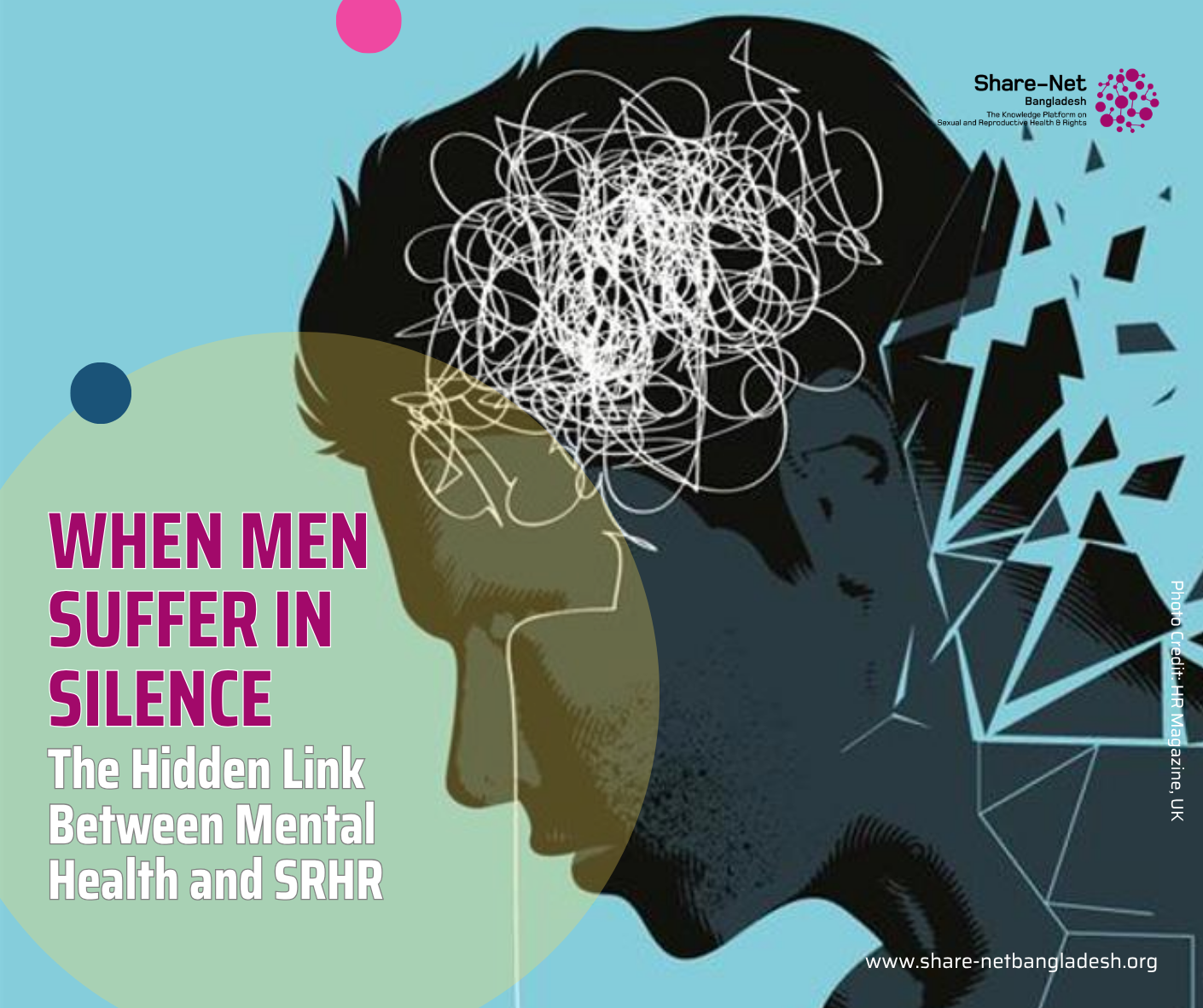
When Men Suffer in Silence: The Hidden Link Between Mental Health and SRHR
A society that teaches boys to hide their emotions should not be surprised when men struggle to ask for help. In Bangladesh, the pressure to appear strong, earn a living and meet expectations of masculinity can turn emotional distress into a private burden. The consequences extend beyond individual wellbeing, affecting relationships, sexual health and the wider struggle for gender equality.
Discussions about men’s mental health are gaining attention in Bangladesh. Two recent contributions, Chum Wellness’s guide to depression in men and Youth Policy Forum Bangladesh’s article on legal gaps and systemic barriers, raise an important question: are men receiving the support they need, or are social expectations and institutional shortcomings keeping their struggles out of sight?
The issue deserves attention, but it also requires evidence beyond assumptions about how men behave.
The numbers reveal a wider challenge
Bangladesh’s National Mental Health Survey, conducted in 2019 and published in 2021, estimated that 18.7% of adults experienced a mental disorder. The prevalence was 15.7% among men and 21.5% among women. Depressive disorders affected an estimated 6.7% of adults. These findings challenge the idea that mental health problems are rare, while reminding policymakers that women’s mental health needs also demand attention.
Access to treatment remains another major concern. Initial findings from the national survey reported that 92.3% of adults with mental disorders did not receive treatment. The World Health Organization has also highlighted shortages of mental health professionals and the need to integrate care into primary healthcare services.
These figures are not specific to men. However, they expose a system in which many people may struggle to obtain appropriate support, regardless of gender.
When masculinity shapes health decisions
Chum Wellness highlights how depression in men may be overlooked when distress appears as irritability, withdrawal, overwork or persistent physical complaints rather than visible sadness. Such signs are not proof of depression, but they can be reasons to check in and encourage professional assessment. The article also identifies expectations that men must remain emotionally strong and financially successful as possible barriers to seeking help.
Research published in the Journal of Health, Population and Nutrition in 2022 adds an important sexual and reproductive health dimension. A mixed-methods study involving 311 married men and 60 in-depth interviews found that concerns about sexual performance, virility and masculinity shaped men’s health worries and their choices of care providers. Informal providers were popular in the study areas, raising concerns about access to reliable advice and appropriate treatment. The findings are informative, although they should not be treated as representative of every Bangladeshi man.
This is where mental health and sexual and reproductive health and rights (SRHR) intersect. Shame about sexual difficulties can discourage men from seeking qualified care. Relationship stress and emotional distress may also affect communication, intimacy and shared reproductive decisions. These connections call for sensitive, evidence-based services rather than assumptions that all men experience distress in the same way.
Beyond awareness, towards accountability
The World Health Organization argues that SRHR programmes must challenge harmful gender norms and engage men and boys alongside women, rather than treating male participation as an end in itself.
Bangladesh therefore needs more than campaigns telling men to open up. It needs affordable counselling, trained providers, confidentiality, stronger referral systems and public education that makes seeking help socially acceptable. Policymakers should also address service gaps and evaluate whether existing mental health protections translate into accessible care.
The real measure of progress is not how often men are told to be strong, but whether they can acknowledge a problem and receive support without shame. A healthier society must make room for men to speak, women to be heard, and everyone to access care with dignity.
Source: