
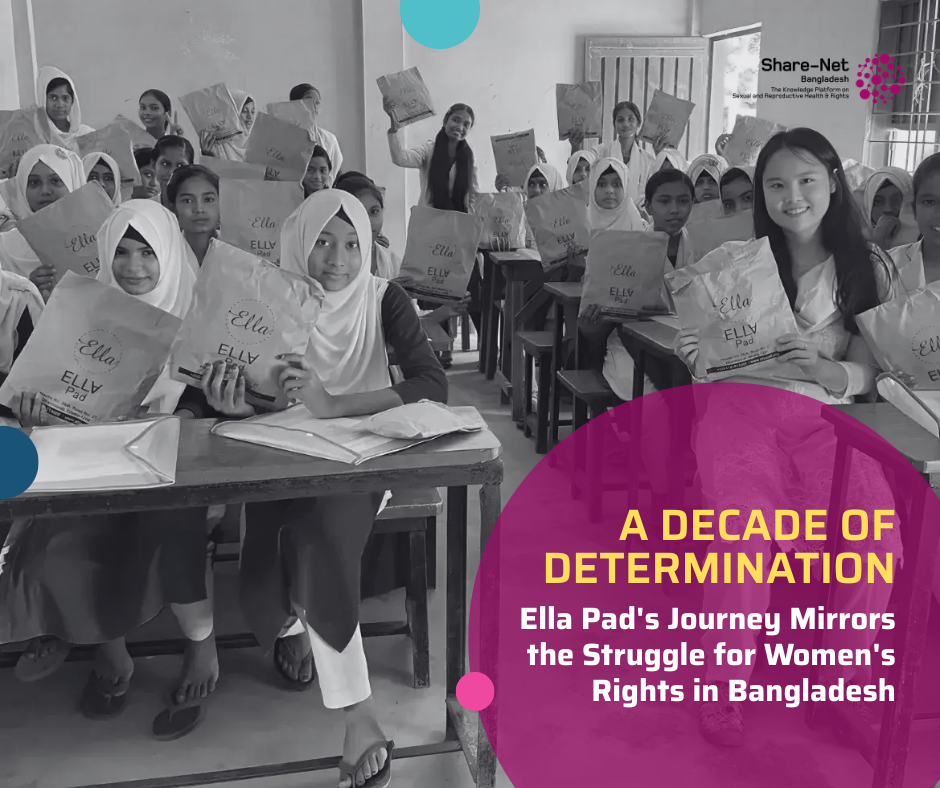
A Decade of Determination: Ella Pad’s Journey Mirrors the Struggle for Women’s Rights in Bangladesh
After nearly a decade of administrative barriers, Ella Pad, a social enterprise to provide affordable sanitary napkins, has finally secured legal recognition. Yet the story raises a larger question. How many grassroots initiatives addressing Sexual and Reproductive Health and Rights (SRHR) and Gender-Based Violence (GBV) never make it this far?
Founded to improve menstrual health and economic opportunities for women, Ella Pad has spent years training rural women to produce reusable sanitary pads while promoting menstrual dignity. During that journey, the organisation encountered an unexpected obstacle. Existing regulations prevented several of its own rural women entrepreneurs from becoming members because they lacked formal education.
That irony exposes a wider challenge in Bangladesh’s development landscape. Communities are often expected to lead social change, but the very people driving that change can be excluded by outdated systems.
Reflecting on the experience, co-founder Mahira Mamun said,
“In Silicon Valley, starting a business, even a non-profit, can take just 10 minutes. It made me realise how much has to change back home.”
The comparison is less about speed and more about opportunity. Innovation cannot flourish where bureaucracy consistently outweighs community leadership.
The relevance extends well beyond menstrual health. According to the World Health Organization, nearly one in three women worldwide experiences physical or sexual violence during her lifetime. In Bangladesh, the Bangladesh Bureau of Statistics’ Violence Against Women Survey found that more than 70 percent of ever-married women have experienced some form of intimate partner violence in their lifetime. Research from UNFPA also shows that poor menstrual health management, gender inequality, and harmful social norms often reinforce one another, increasing girls’ vulnerability to school dropout, child marriage, and violence.
This is why women-led social enterprises deserve greater policy attention. They do not simply distribute products. They create safe spaces where conversations about menstruation, bodily autonomy, reproductive health, and gender equality become possible. Economic participation also strengthens women’s confidence, decision-making power, and resilience against abuse.
Ella Pad’s decision to appoint four rural women to its governing board is equally significant. It shifts leadership from urban boardrooms to community voices. As board member Asia Begum put it, “Ella Pad gave me dignity when society had none for me.” That sentence captures something many policies struggle to achieve. Dignity is often the first step toward empowerment.
Bangladesh has made notable progress in girls’ education, maternal health, and reducing extreme poverty. However, ending GBV requires moving beyond reactive services. It demands investment in community-led initiatives that combine economic empowerment, SRHR education, leadership development, and local ownership.
Ella Pad’s licence is not simply the end of a bureaucratic journey. It is evidence that when barriers are removed, grassroots women can become powerful agents of social change. The challenge now is ensuring that many more organisations do not have to wait another decade before their work receives the recognition and support it deserves.
Sometimes the biggest victories are not measured by awards or headlines. They are measured by how many doors finally open after years of staying shut. Ella Pad’s long-awaited non-profit licence is one such moment. It is a reminder that empowering women is not only about launching innovative ideas. It is also about creating systems that allow those ideas to survive, grow, and reach the people who need them most.
