
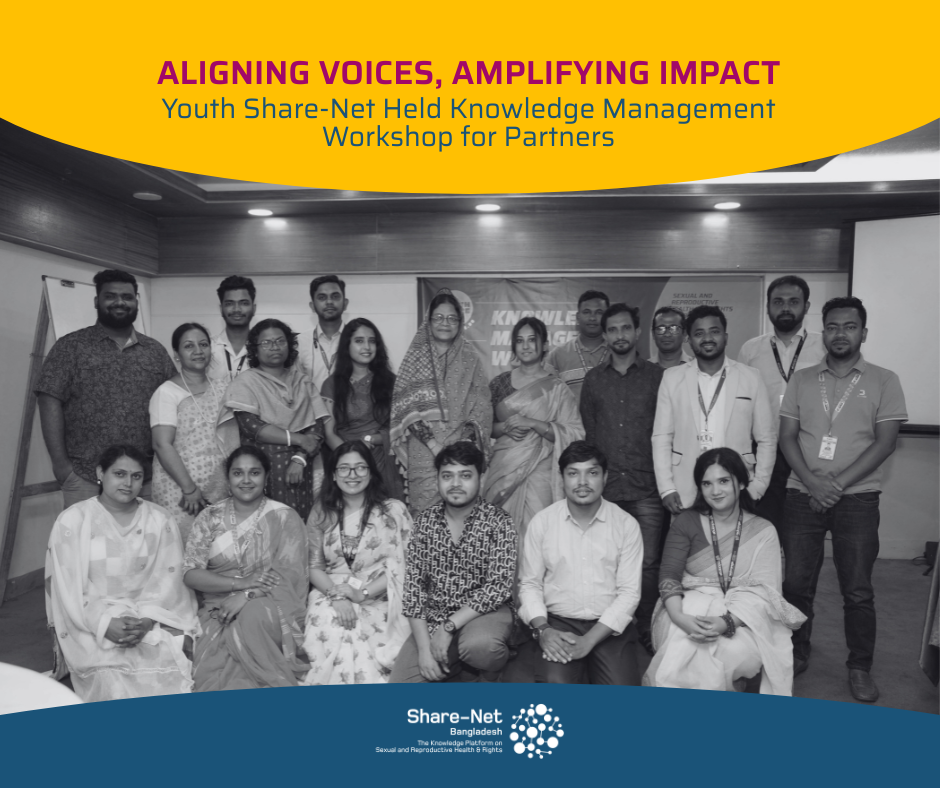
Aligning Voices, Amplifying Impact: Youth Share-Net Held Knowledge Management Workshop for Partners
When youth voices align, systems begin to shift. In Bangladesh, where adolescent pregnancy, child marriage, and limited access to modern contraceptives continue to shape the realities of young people, fragmented efforts have long diluted impact. Against this backdrop, the Youth Share-Net (YSN) Knowledge Management Workshop, held on April 23, 2026 in Dhaka, had marked a deliberate move away from isolated interventions toward coordinated, youth-led action in Sexual and Reproductive Health and Rights (SRHR).
Bangladesh had continued to face persistent SRHR challenges. Recent estimates had shown that around 27 percent of adolescents experienced pregnancy, while nearly 59 percent of girls had been married before 18. Despite multiple interventions by NGOs and development actors, gaps in coordination had resulted in duplicated efforts and inconsistent messaging. The YSN initiative had sought to address this structural inefficiency by bringing together six youth-led organisations under a shared knowledge management framework.
The workshop had served as a critical convergence point. Facilitated by RedOrange and supported by AmplifyChange, it had brought together organisations including AVAS, DALIT, Prantoz Foundation, SERAC-Bangladesh, YAD, and YPSA. Participants had engaged in structured sessions designed to align strategies, strengthen capacity, and co-create tools for long-term collaboration.
At its core, the workshop had focused on five knowledge management pathways: generation, translation, sharing, promotion, and networking. These had not been treated as abstract concepts but as actionable systems. Through participatory sessions, partners had worked to “align on the project’s goals, strengthen knowledge management capacities, and build inter-organisational relationships,” a process that had laid the foundation for sustained collective impact.
A major milestone had been the collaborative finalisation of the Theory of Change and Monitoring and Evaluation framework. By grounding decisions in baseline data and shared indicators, the partners had aimed to move beyond activity-driven programming toward measurable outcomes. This had reflected a growing shift in Bangladesh’s SRHR landscape, where evidence-based programming and accountability are increasingly seen as essential.
The discussions had also extended into fundraising and networking strategies, areas often overlooked in youth-led initiatives. By focusing on donor mapping, storytelling, and digital engagement, the workshop had equipped participants with practical tools to sustain their interventions. This had been particularly significant in a context where youth organisations frequently face resource constraints despite their grassroots reach.
Importantly, the workshop had reinforced a key insight: collaboration is not optional in addressing SRHR challenges. It is essential. Fragmentation had previously limited scale and consistency. This initiative had attempted to reverse that trend by creating a unified platform where knowledge flows freely and strategies align.
While the workshop itself had been a positive step, its long-term impact will depend on implementation. The joint action plan developed during the sessions had outlined clear responsibilities, but translating plans into measurable change remains the real test. If executed effectively, this model could offer a scalable framework for youth-led SRHR programming across Bangladesh.
In a country where young people continue to navigate complex reproductive health challenges, the shift from fragmented action to collective strategy may prove decisive. The YSN workshop had not just been a meeting. It had been a signal that the future of SRHR in Bangladesh could be more connected, more evidence-driven, and firmly led by youth voices.
