
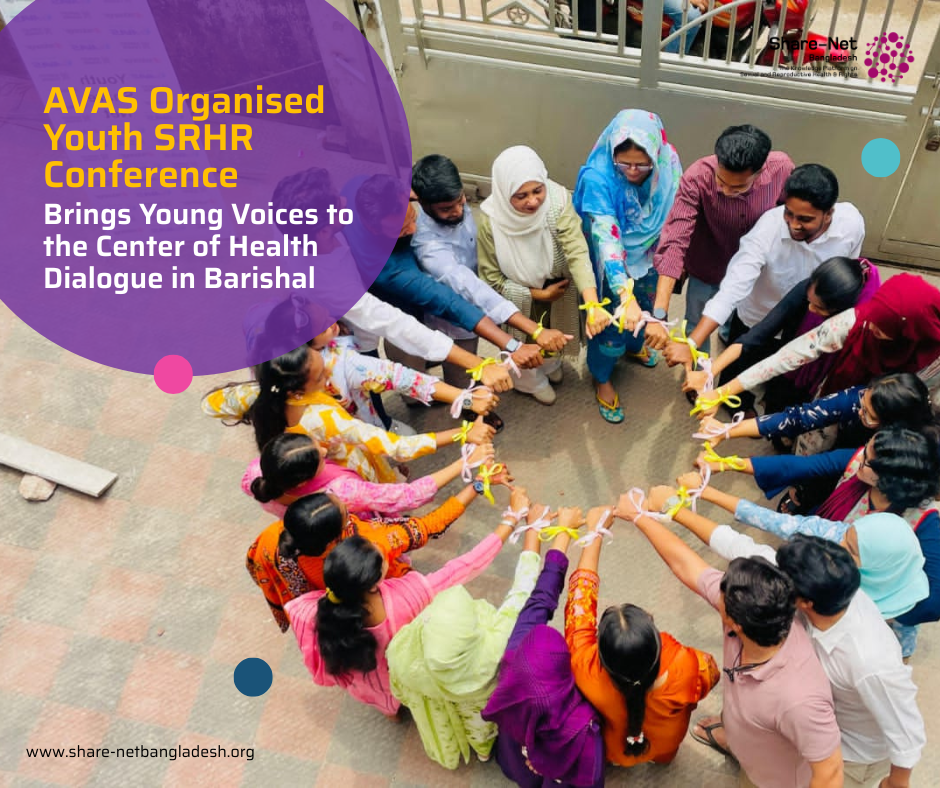
AVAS Organised Youth SRHR Conference: Brings Young Voices to the Center of Health Dialogue in Barishal
For many young people in Bangladesh, conversations around sexual and reproductive health rights (SRHR) still happen in silence, shaped by stigma, limited awareness, and social hesitation. Against this backdrop, a recent youth-led conference in Dhaka created a space where those silences were replaced with questions, dialogue, and lived experiences.
A day-long Youth Conference under the Youth Share-Net project, focused on Community of Practice (CoP), was held on Sunday (10 May) at AVAS Training Centre in Barishal. Organised by RedOrange, supported by AmplifyChange, and implemented by AVAS, the event brought together school and college students, youth network members, teachers, and young advocates to strengthen understanding of SRHR and youth leadership in Bangladesh.
At its core, the conference aimed to improve awareness, leadership skills, and knowledge sharing among adolescents on sexual and reproductive health issues. Organisers said the CoP model was designed to help young people learn from each other, reflect on real challenges, and develop practical solutions.
Participants actively shared their experiences of school-based SRHR campaigns, personal learning journeys, and the barriers they face in discussing sensitive health topics in their communities. As one participant reflected during the discussions, “Youth voices and experiences can build a stronger Community of Practice for SRHR awareness.”
The conference featured interactive panel discussions, group work, open forums, and idea exchange sessions. These participatory formats allowed young people not just to listen, but to lead conversations on issues that directly affect them.
Resource person Mahbuba Akter facilitated key sessions focusing on adolescent SRHR education and community engagement. AVAS Executive Director Rahima Sultana Kajol attended as Chief Guest and emphasised the importance of creating safe and inclusive spaces for youth participation. Media representative Monika Chowdhury from Jugantor also contributed insights on how communication and media can play a stronger role in SRHR awareness.
Across sessions, participants highlighted persistent challenges including social taboos, lack of accurate information, and limited youth-friendly health education in schools. At the same time, discussions also focused on solutions such as peer education, school-based awareness campaigns, and stronger youth-led networks.
Experts and speakers stressed that when young people are included in decision-making processes, they are better able to design relevant and practical solutions for their communities. The CoP approach, they noted, offers a structured way to turn youth experiences into collective learning and action.
The event, attended by around 20 to 25 participants, also included documentation of experiences, problem analysis, and solution-based planning exercises. Organisers said this approach helps translate discussion into actionable steps for future SRHR initiatives.
As the session concluded, participants shared reflections on what they had learned and how they planned to apply it in their schools and communities. The energy in the room suggested something important: youth are not just recipients of SRHR information, but active contributors to shaping its future.
The Youth Share-Net project reaffirmed its commitment to continuing such inclusive and participatory initiatives, ensuring that young people remain at the center of SRHR awareness, dialogue, and action in Bangladesh.
In a country where silence around reproductive health still shapes many young lives, initiatives like this are slowly turning conversation into confidence, and awareness into action.