
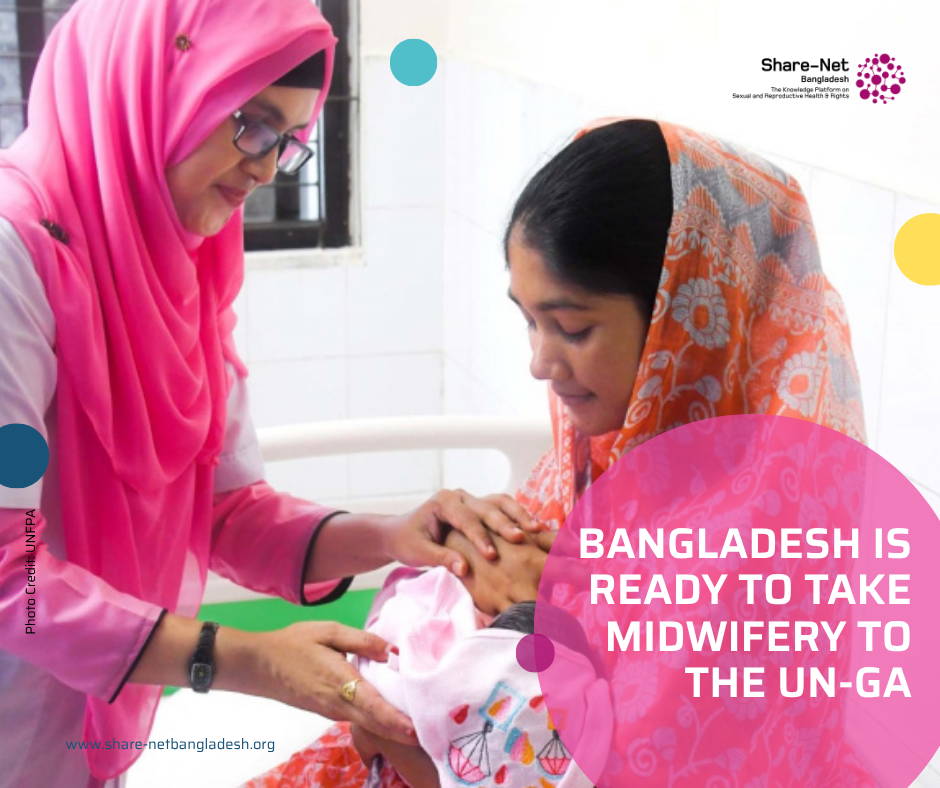
Bangladesh is ready to Take Midwifery to the UN-General Assembly
A safe pregnancy should not depend on where a woman lives, how much her family earns or how far she must travel to reach a health facility. Yet for many women, access to skilled and respectful maternity care remains a challenge. Bangladesh’s plan to strengthen professional midwifery, including a commitment to create 25,000 midwife positions by 2030, brings an important question to the global health agenda: how can political commitments translate into care that reaches women when and where they need it?
At the 81st Session of the United Nations General Assembly in New York, Bangladesh and Sweden are expected to co-host a high-level event with the United Nations Population Fund (UNFPA) on September 24, 2026. The discussion, titled From Commitment to Action: Integrating Midwifery into Primary Health Care to End Preventable Maternal and Newborn Deaths, is intended to build on ongoing efforts to strengthen maternal and newborn health.
The proposed event follows Bangladesh’s June 2026 announcement of plans to create and deploy 25,000 midwives across its public health system by 2030. UNFPA described the commitment as the largest investment in the country’s midwifery workforce to date.
The focus is significant because midwifery is not limited to assisting childbirth. Properly trained midwives can provide antenatal and postnatal care, family planning information, and other essential sexual and reproductive health services. They can also help identify complications early and support referrals when specialised treatment is needed.
The evidence supports investing in this workforce. A 2021 report by WHO, UNFPA and the International Confederation of Midwives estimated a global shortage of 900,000 midwives. It also found that midwives educated to international standards, properly regulated and integrated into health systems could provide around 90% of essential sexual, reproductive, maternal, newborn and adolescent health interventions.
For Bangladesh, however, the number of promised positions will be only one measure of progress. Training quality, fair deployment, adequate supplies, supportive supervision and safe working conditions will determine whether midwives can deliver effective care. Rural and underserved communities need particular attention, while women must be able to access services without discrimination or disrespect.
The planned UN dialogue will also examine financing, workforce retention and the integration of midwives into primary health care and universal health coverage. These are practical questions, not simply technical details. Without sustained funding and functioning referral systems, expanding the workforce alone cannot guarantee better outcomes.
Bangladesh’s international engagement offers an opportunity to connect its domestic commitment with a wider movement for equitable health care. But the real measure of success will be found beyond the UN meeting rooms.
Can the promise of 25,000 midwives become accessible, respectful and reliable care for women in every community?
That is where the commitment must ultimately be tested.
https://www.tbsnews.net/bangladesh/bangladesh-champion-midwifery-primary-health-care-un-general-assembly-1542486
