
From Conversation to Change: Youth Leadership Matters in Ending Child Marriage and Adolescent Pregnancy
Child marriage and adolescent pregnancy are often discussed as statistics, legal issues, or public health concerns. But behind every number is a young person whose education is interrupted, whose health is compromised, or whose future becomes limited before adulthood even begins. Addressing these challenges requires more than stronger laws. It demands listening to young people, understanding local realities, and creating systems where they can actively shape solutions.
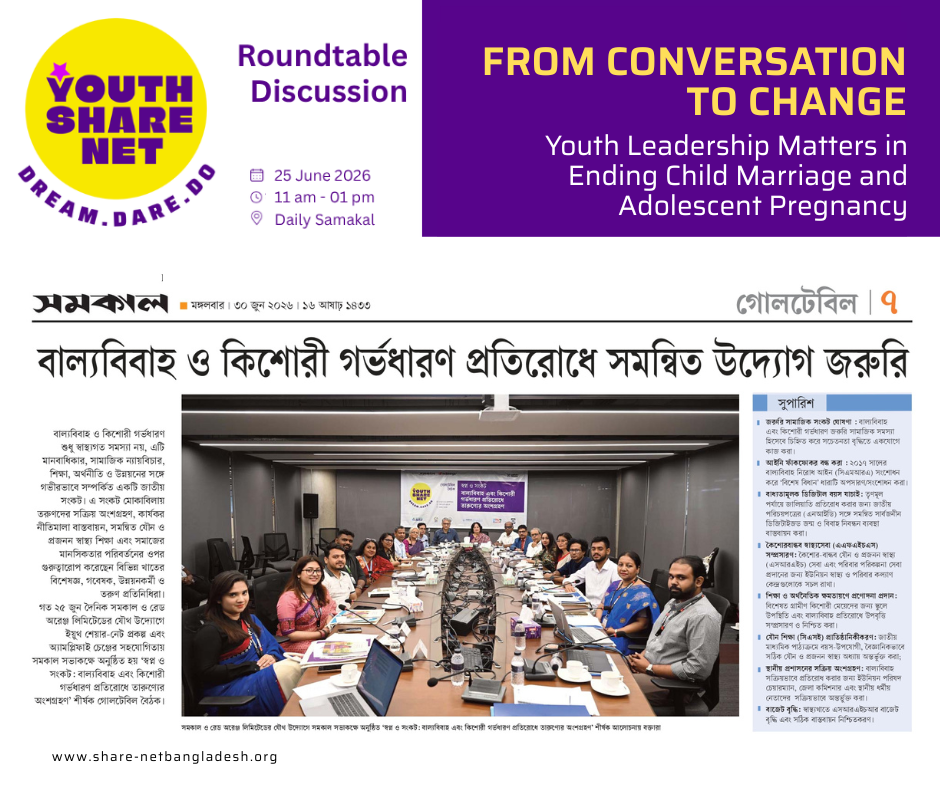
That message emerged clearly during the roundtable discussion titled “Challenges and Crisis: Youth Engagement in Preventing Child Marriage and Adolescent Pregnancy,” jointly organised by The Daily Samakal and Red Orange Limited under the Youth Share-Net Project, with support from AmplifyChange. Bringing together policymakers, researchers, development practitioners, health professionals, journalists and youth leaders, the discussion explored why child marriage remains one of Bangladesh’s most persistent Sexual and Reproductive Health and Rights (SRHR) challenges despite decades of interventions.
Rather than treating Bangladesh as a single story, the discussion highlighted how geography, climate, poverty and social norms create different realities across the country. Speakers described how coastal communities affected by climate disasters, remote hill districts, river erosion areas, Dalit communities and ethnically diverse populations all face unique barriers to education, healthcare and SRHR information. A one-size-fits-all approach, they argued, cannot effectively address child marriage or adolescent pregnancy.
The conversation also moved beyond legal reforms. While stronger enforcement of the Child Marriage Restraint Act remains important, participants repeatedly stressed that sustainable progress depends on comprehensive sexuality education, adolescent-friendly health services, stronger school-based protection systems, digital age verification, and meaningful youth participation in policymaking. These recommendations reflect an understanding that prevention must begin long before a marriage is arranged.
One of the strongest themes throughout the discussion was the need to recognise young people as partners rather than passive beneficiaries. Participants noted that adolescents often receive fragmented or inaccurate information about sexual and reproductive health, while social stigma discourages open conversations within families and communities. Youth-led awareness campaigns, peer education and digital engagement were identified as practical ways to bridge these information gaps.
The Youth Share-Net Project itself represents this shift in thinking. Operating from 2025 to 2028 across five divisions, the initiative focuses on building youth leadership, strengthening SRHR knowledge, and ensuring that the voices of marginalised communities influence both local action and national dialogue. Knowledge fairs and community engagement activities have already created new spaces where young people can share experiences, challenge harmful social norms and advocate for evidence-based solutions.
The discussion concluded with an important reminder. Child marriage and adolescent pregnancy are not only health issues. They are questions of human rights, gender equality, education, social justice and sustainable development. Progress will depend not only on policies written in government offices, but also on whether communities are willing to trust young people as leaders of change.
In the end, perhaps the most powerful message from the roundtable was also the simplest. Lasting change begins when young people are no longer spoken about, but are given the opportunity to speak for themselves, influence decisions and shape the future they deserve.
Download the Full Supplement of the Roundtable
