
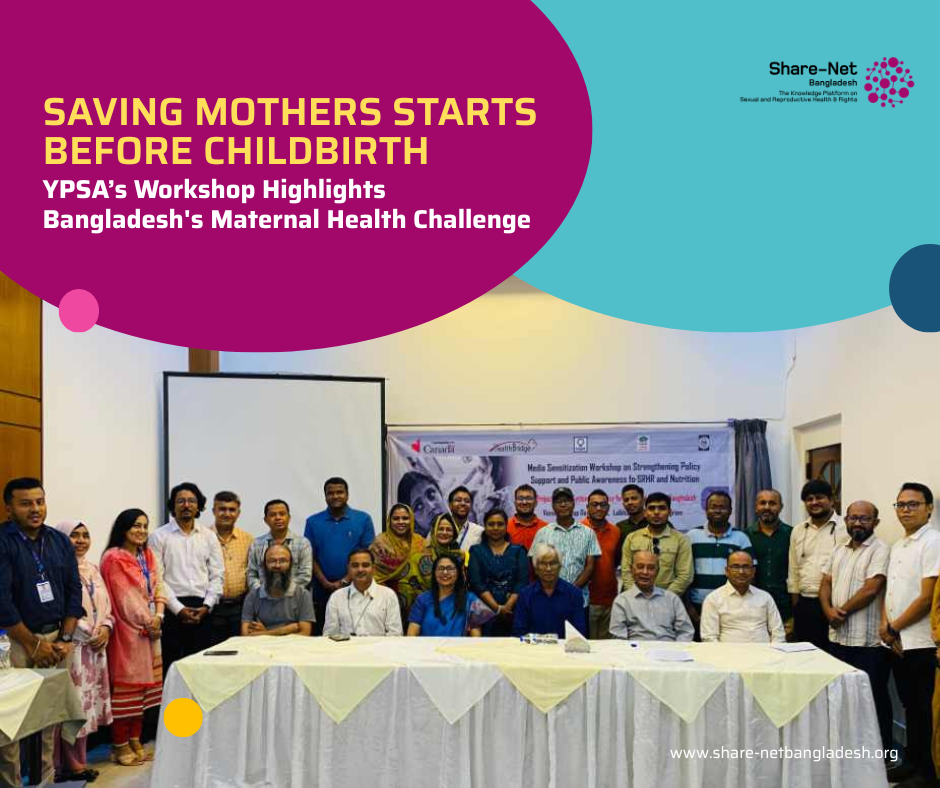
Saving Mothers Starts Before Childbirth: YPSA’s Workshop Highlights Bangladesh’s Maternal Health Challenge
Every maternal death leaves behind more than a grieving family. It reveals missed opportunities in healthcare, gaps in public awareness, and a system that still struggles to reach every woman who needs care. While Bangladesh has made notable progress in reducing maternal mortality over the past two decades, health experts warn that preventable deaths remain an urgent public health challenge that requires stronger community awareness and quality healthcare services.
These concerns took centre stage at a media sensitisation workshop organised by Young Power in Social Action (YPSA) in Chattogram on 21 July under the project Health Systems Resilience for Improved Sexual and Reproductive Health Services in Bangladesh. Bringing together health professionals, journalists and development practitioners, the workshop focused on Sexual and Reproductive Health and Rights (SRHR), maternal nutrition, family planning, and the media’s responsibility in promoting evidence-based public health information.
The discussions painted a mixed picture. Bangladesh has significantly reduced maternal mortality over the years, yet around 123 mothers still die for every 100,000 live births, largely due to pregnancy, childbirth, or postnatal complications. Experts also noted that 92 out of every 1,000 girls aged 15 to 19 become mothers, highlighting the continued burden of adolescent pregnancy.
According to the World Health Organization, almost all maternal deaths worldwide are preventable with timely access to skilled healthcare, quality antenatal services, safe delivery, and postnatal care. Similarly, UNFPA Bangladesh has repeatedly emphasised that expanding access to quality SRHR services remains essential for achieving the Sustainable Development Goals.
One of the strongest messages from the workshop challenged a common misconception that reproductive health concerns only women.
“Sexual and reproductive health is not solely a women’s issue. It is a fundamental right for both men and women,” said Shamima Akter Chowdhury, Team Leader of the BAPSA project.
The workshop also highlighted another overlooked issue. Nearly 27 percent of people who want to use modern contraceptive methods are still unable to access appropriate services, creating additional risks of unintended pregnancy and poor maternal health outcomes.
Nutrition also featured prominently in the discussions. Participants shared national data showing that 24 percent of children under five are stunted, while 12.9 percent suffer from wasting. Although 56 percent of infants receive exclusive breastfeeding during their first six months, experts agreed that better maternal nutrition before and after childbirth remains critical for improving child health.
Government health officials stressed the importance of institutional deliveries, warning that home births conducted by untrained attendants continue to put mothers and newborns at unnecessary risk.
The workshop also recognised the media as an important partner in public health. Speakers argued that responsible journalism can help challenge harmful myths, counter misinformation, and encourage families to seek professional healthcare rather than relying on unsafe traditional practices.
Bangladesh has already demonstrated that sustained investment in maternal health can save lives. The challenge now is ensuring that these gains reach every woman, regardless of where she lives or her economic background. As the conversations in Chattogram made clear, reducing maternal deaths will depend not only on stronger health systems, but also on informed communities, accessible services, and accurate public information.