
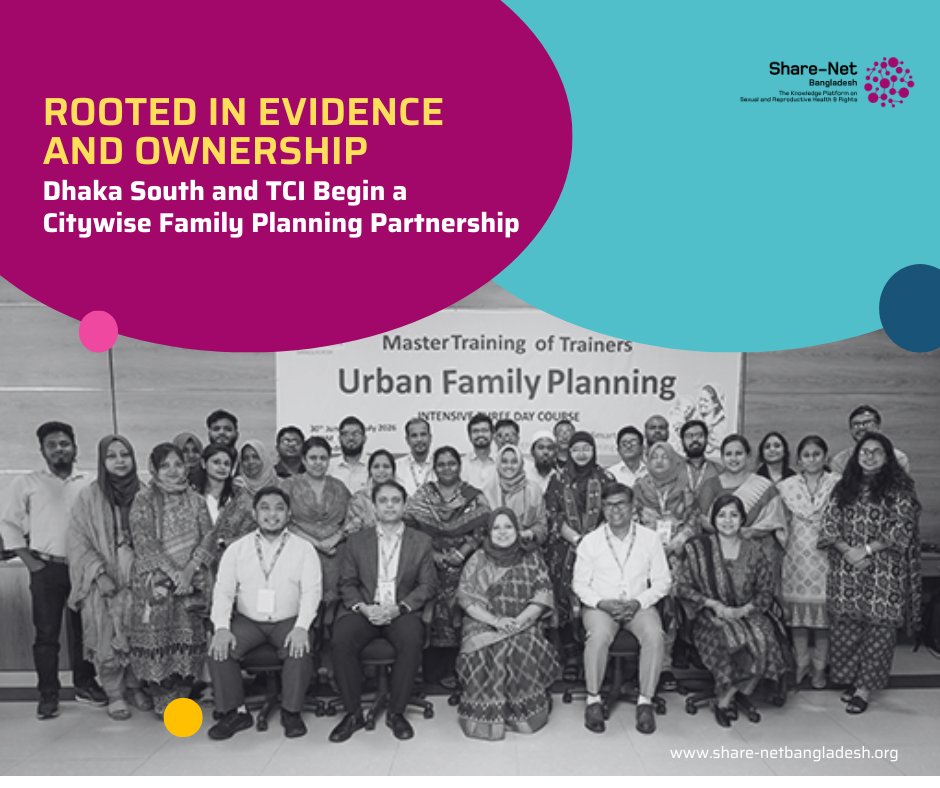
Rooted in Evidence and Ownership: Dhaka South and TCI Begin a Citywise Family Planning Partnership
Strong health systems are not built overnight. They grow when governments, health workers, and communities come together to solve problems from within. That was the spirit behind a three-day Program Design Workshop and Master Training of Trainers held in Gazipur, where Bangladesh took an important step toward strengthening urban family planning through local leadership rather than external intervention.
Led by The Challenge Initiative (TCI) in partnership with Dhaka South City Corporation (DSCC) and SAJIDA Foundation, the workshop marked the beginning of a city-owned approach to improving voluntary family planning services. Instead of creating a parallel project, the initiative focused on strengthening existing government systems so cities can design, implement, and sustain their own solutions.
The timing is significant. Bangladesh is now more than 41 percent urban, with cities expanding rapidly every year. Yet behind encouraging national health indicators lies another reality. Urban slums and underserved communities continue to experience unequal access to quality Sexual and Reproductive Health and Rights (SRHR) services, especially family planning.
Workshop participants reviewed baseline data that exposed several critical gaps. Nearly 97 percent of almost 48,000 family planning clients relied on short-acting contraceptive methods, while only 2 percent used long-acting reversible contraceptives (LARCs). Around 42 percent of assessed health facilities lacked private counselling rooms, limiting confidential services for adolescents and vulnerable groups. Only about one-third of frontline providers had received recent family planning counselling training.
Rather than treating these findings as statistics alone, participants worked through an “Evidence-to-Action” process. Using root cause analysis and fishbone diagrams, multidisciplinary teams identified why service gaps exist and developed practical solutions tailored to Dhaka South’s needs.
One of the workshop’s strongest moments came during discussions on adolescent health. Faria Foez from DSCC’s City Health Department asked a question that captured a wider challenge.
“If the teacher himself excludes the chapter on puberty, how will we reach the students?”
Her concern reflected how silence around puberty and sexuality education leaves many adolescents dependent on misinformation, social stigma, and unreliable online sources. Supporting this concern, Deputy Chief Health Officer Dr. Nishat noted that urban health centres are witnessing an alarming increase in teenage and unintended pregnancies.
The workshop also highlighted that technical solutions alone cannot solve systemic problems. Data quality, workforce shortages, and fragmented leadership remain major barriers. As Dr. Abu Sadat Mohammed Saleh observed, meaningful leadership begins when every sector accepts ownership of its responsibilities.
The roadmap developed during the workshop proposes practical next steps, including integrating family planning counselling into child vaccination visits, introducing evening clinics for garment workers, improving data management, creating male-friendly service spaces, and replacing one-off training sessions with continuous coaching.
With TCI officially launching its Bangladesh programme earlier this year, the Gazipur workshop signals more than a new project. It reflects a shift in thinking where cities become architects of their own health systems. If sustained, this model could help Bangladesh build more resilient, inclusive, and youth-responsive SRHR services while ensuring that local solutions remain at the heart of urban health reform.