
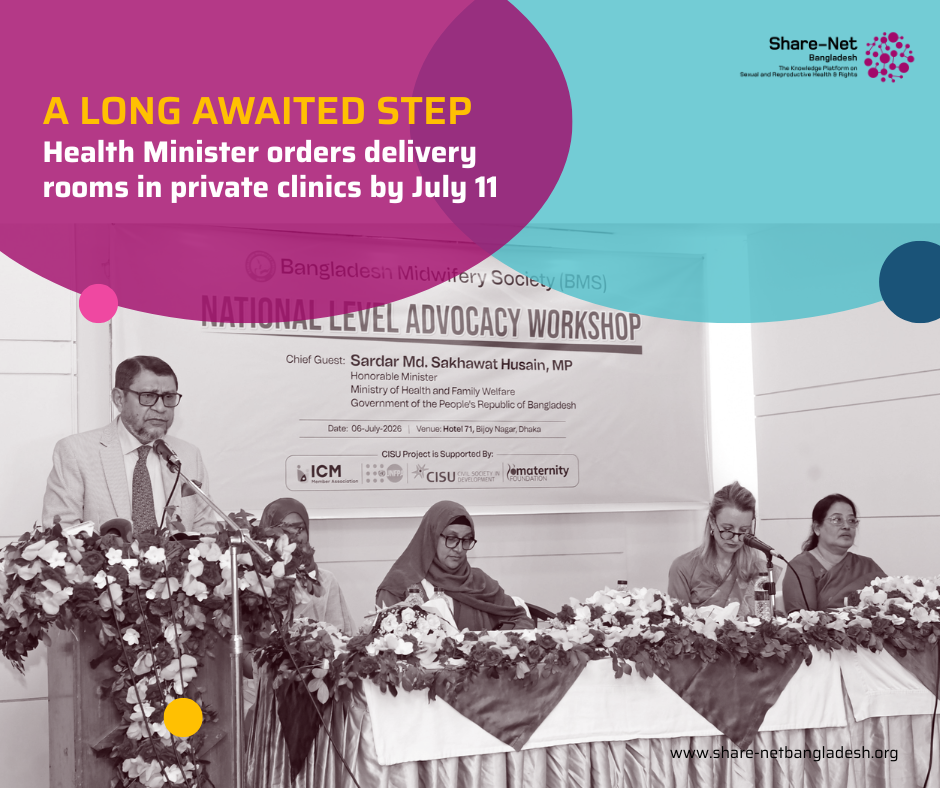
A Long Awaited Step: Health Minister Orders Delivery Rooms in Private Clinics & Hsopitals by July 11
In a strong policy move, Health and Family Welfare Minister Sardar Md. Sakhawat Husain has directed all private clinics and hospitals to establish functional delivery rooms by July 11, warning that institutions failing to comply could lose their licences. The announcement sends a clear message that safe normal delivery must once again become a priority in Bangladesh’s healthcare system.
“The mandatory establishment of delivery rooms in all private clinics and hospitals must be completed by July 11. Otherwise, the licences of the respective institutions will be cancelled,” the minister said while addressing a workshop organised by the Bangladesh Midwifery Society.
The decision directly targets the country’s growing dependence on Caesarean births in private facilities. Recent research using the 2022 Bangladesh Demographic and Health Survey found that the national C-section rate had reached 69.3 percent, with the highest rates among wealthier families and private health facilities. Researchers warned that the trend reflects widening inequalities and the overuse of surgical childbirth beyond medical need.
The minister alleged that some clinics and intermediaries deliberately frighten expectant families by overstating pregnancy risks, convincing them that surgery is the only safe option. Health experts have long argued that while Caesarean sections are life-saving when medically indicated, unnecessary operations expose mothers to avoidable surgical complications, longer recovery periods, higher healthcare costs, and increased risks in future pregnancies.
Bangladesh has made remarkable progress in reducing maternal deaths over the past two decades, but challenges remain. According to the latest national Maternal and Perinatal Death Surveillance and Response report, the country’s maternal mortality ratio stood at 136 deaths per 100,000 live births, still far from the Sustainable Development Goal target of fewer than 70 by 2030. The report highlights the importance of improving facility readiness, referral systems, and quality maternity care.
A major part of the government’s response is investing in skilled midwives. The minister announced plans to recruit 100,000 new health workers, including 80,000 women, with most expected to serve in midwifery roles. The expansion reflects growing evidence that midwife-led care improves access to respectful maternity services and supports safe normal births. UNFPA reports that its supported midwives have already helped deliver more than 154,000 babies safely, while strengthening maternity services in targeted districts.
The announcement also arrives at a time when Bangladesh is strengthening its maternal health monitoring systems. National surveillance now provides real-time information on maternal deaths, birth outcomes, and facility performance, helping policymakers identify service gaps and improve accountability.
Reducing unnecessary Caesarean sections is not about discouraging surgery when it is genuinely needed. It is about restoring informed choice, medical ethics, and evidence-based care to childbirth.
For Bangladesh’s SRHR movement, the real measure of success will not be the number of delivery rooms built or regulations introduced. It will be whether every pregnant woman can make informed decisions, receive respectful care, and give birth in a system where health comes before profit.
