
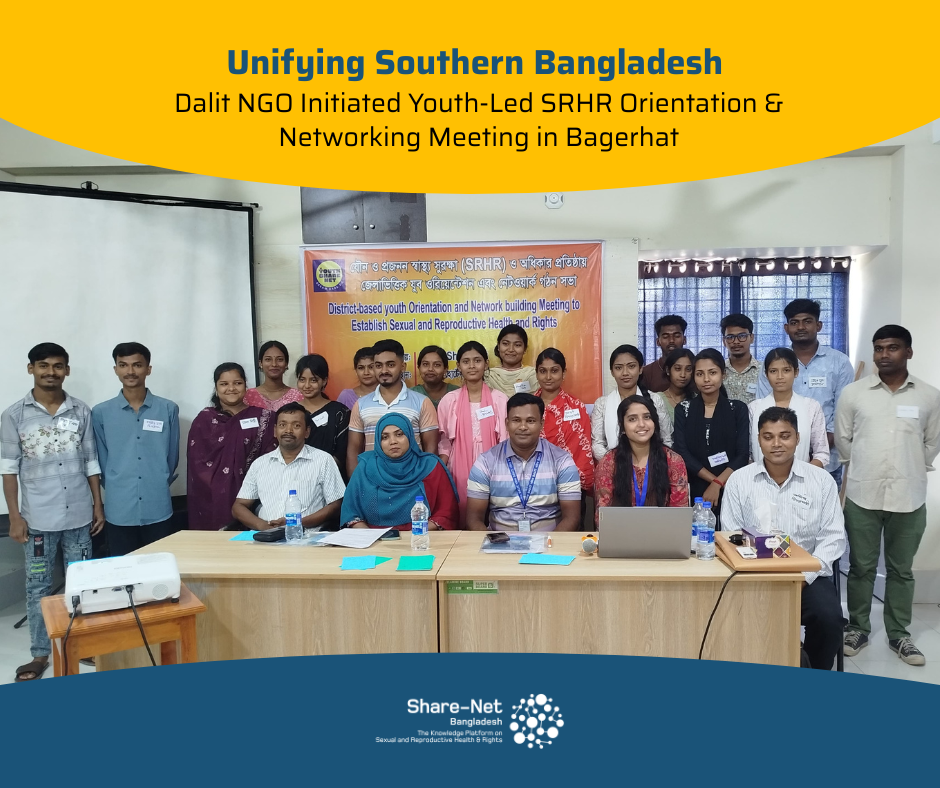
Unifying Southern Bangladesh: Dalit NGO Initiated Youth-Led SRHR Networking Meeting in Bagerhat
In many communities across Bangladesh, conversations about sexual and reproductive health still remain hidden behind shame, fear, and social discomfort. For adolescents and marginalised youth, this silence often creates confusion, misinformation, and long-term health risks. But in Bagerhat, a small group of young people recently gathered with a different message in mind: silence must be broken before meaningful protection and dignity can begin.
On Monday (11 May), a district-level orientation session on Sexual and Reproductive Health and Rights (SRHR) was held at Dhansiri Hotel and Restaurant in the Dashani area of Bagerhat. Organised under the Youth Share-Net project, the initiative was implemented by DALIT with support from RedOrange Bangladesh and funding from AmplifyChange.
The event brought together around 20 participants, including Dalit youth, students, and local youth representatives, creating a space for dialogue on reproductive health awareness, youth leadership, and social inclusion.
The programme carried a powerful message: “Break the silence, build protection, ensure bodily dignity and rights.” The slogan reflected a growing effort to challenge long-standing stigma around SRHR discussions in Bangladesh, particularly among socially excluded communities.
The session was chaired by Shyamal Das of the Dalit Youth Forum in Mongla-Bagerhat, while Pratap Kumar Das from the Youth Share-Net project facilitated the event. Sharmin Akter, Field Officer of the Department of Women Affairs in Bagerhat, attended as Chief Guest. Shakirun Taha, Project Manager of the Youth Share-Net initiative under DALIT Khulna, also joined the programme.
Throughout the orientation, speakers stressed the importance of increasing reproductive health awareness among young people and creating safe spaces where adolescents can openly discuss issues often considered socially sensitive.
Participants discussed how misinformation, cultural taboos, and social hesitation continue to prevent many young people from accessing accurate SRHR information and support services. Organisers highlighted that without youth-friendly awareness initiatives, many adolescents remain vulnerable to health risks, gender-based discrimination, and early marriage.
The event also focused on building a district youth network that will later lead community-level awareness activities. According to organisers, the newly formed youth group will work directly within local communities to promote reproductive health education and encourage peer-to-peer engagement.
The grassroots approach reflects a broader shift in Bangladesh’s SRHR movement, where young people are increasingly being recognised not only as beneficiaries, but also as advocates and community mobilisers.
Globally, development experts continue to emphasise that youth participation is critical in improving SRHR outcomes. In Bangladesh, where discussions around reproductive health are often restricted by social norms, locally-led youth networks may play a crucial role in creating trust, spreading accurate information, and reducing stigma.
As the programme concluded, participants expressed optimism about becoming active voices for change within their communities. For many, the orientation was not simply a workshop. It was the beginning of a larger effort to reclaim conversations around dignity, rights, and health.
And in places where silence has long shaped young lives, even small conversations can become the first step toward transformation.