
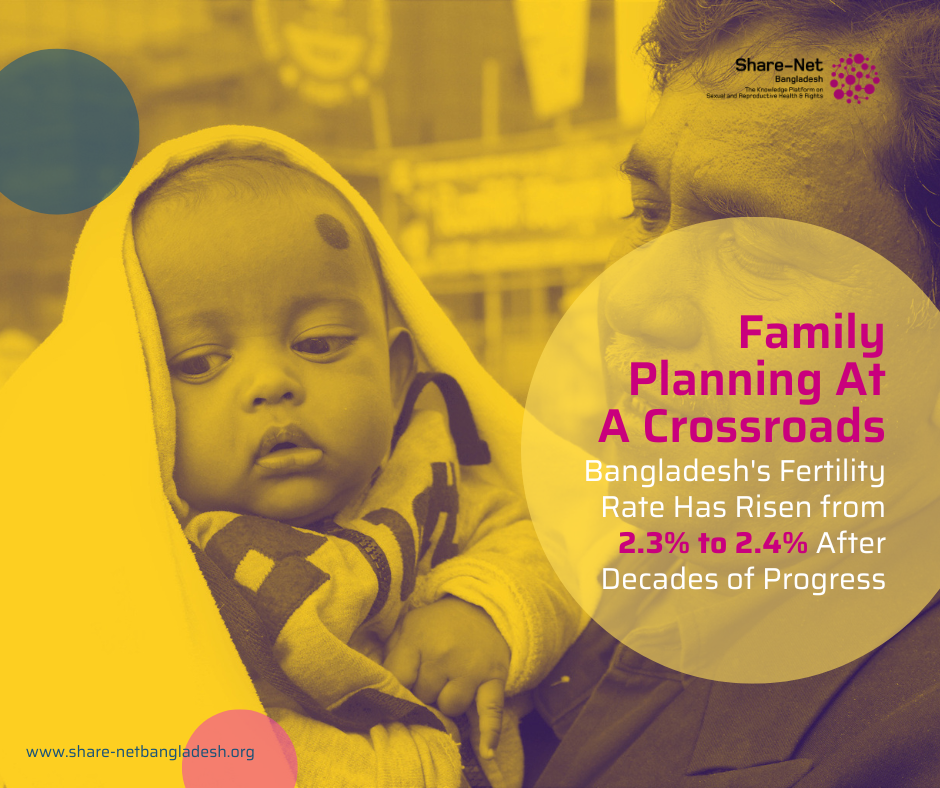
Family Planning At A Crossroads: Why Bangladesh’s Fertility Rate Is Rising Again After Decades of Progress?
For centuries, the pomegranate has symbolised fertility, abundance, and new life across cultures. Its countless seeds have inspired myths, poetry, and celebrations of love and prosperity. But in today’s Bangladesh, fertility is becoming less a symbol of romance and more a matter of public policy and reproductive rights.
For years, Bangladesh was celebrated as a global success story in family planning. The country proved that investments in women’s health, community outreach, and reproductive rights could transform lives and slow population growth. Today, however, a new set of figures suggests that this progress may be losing momentum.
The latest Multiple Indicator Cluster Survey (MICS) 2025 has revealed a concerning trend. Bangladesh’s Total Fertility Rate (TFR) has increased from 2.3 to 2.4 children per woman, marking the first significant reversal after decades of steady decline. While the increase may appear small, public health experts believe it reflects much deeper challenges surrounding Sexual and Reproductive Health and Rights (SRHR), access to family planning, and adolescent wellbeing.
The survey paints a broader picture than fertility alone. Contraceptive use among married women has dropped from 62.7% in 2019 to 58.2% in 2025. At the same time, the proportion of women whose need for modern contraceptives is being met has also declined.
These figures raise an important question. Are family planning services becoming less accessible, or are changing social and economic realities making reproductive healthcare more difficult to reach? Experts believe the answer lies somewhere in between.
The survey also points to one of Bangladesh’s longest-standing SRHR challenges. Child marriage remains alarmingly high, with 56% of women aged 20 to 24 having been married before turning 18. Even more concerning is the sharp rise in adolescent motherhood. According to the survey, 92% of married girls aged 15 to 19 have already become mothers, compared with 83% just a few years earlier.
This is not simply about population growth. Early marriage often interrupts education, limits employment opportunities, increases maternal health risks, and reduces young women’s ability to make informed decisions about their own bodies. From an SRHR perspective, rising fertility is closely linked with gender inequality, limited reproductive choices, and gaps in comprehensive sexuality education.
The encouraging news is that Bangladesh continues to make progress in several health indicators. Institutional deliveries have reached 71%, skilled birth attendance has increased to 77%, and both infant and under-five mortality have declined. These achievements demonstrate that sustained public investment and community-based health programmes can produce measurable results.
The challenge now is to apply the same commitment to family planning and adolescent reproductive health.
Public health specialists are calling for stronger community outreach, uninterrupted contraceptive supplies, better counselling services, and renewed investment in preventing child marriage. They also stress the importance of keeping girls in school and ensuring young people receive accurate, age-appropriate SRHR information before they enter marriage.
Bangladesh has already shown that progress is possible. The current rise in fertility should not be viewed as a crisis beyond control but as an opportunity to strengthen policies that place women, adolescents, and reproductive rights at the centre of national development.
Because behind every fertility statistic is a young person making decisions about education, health, family, and the future. Protecting those choices may be the country’s most important investment yet.
