
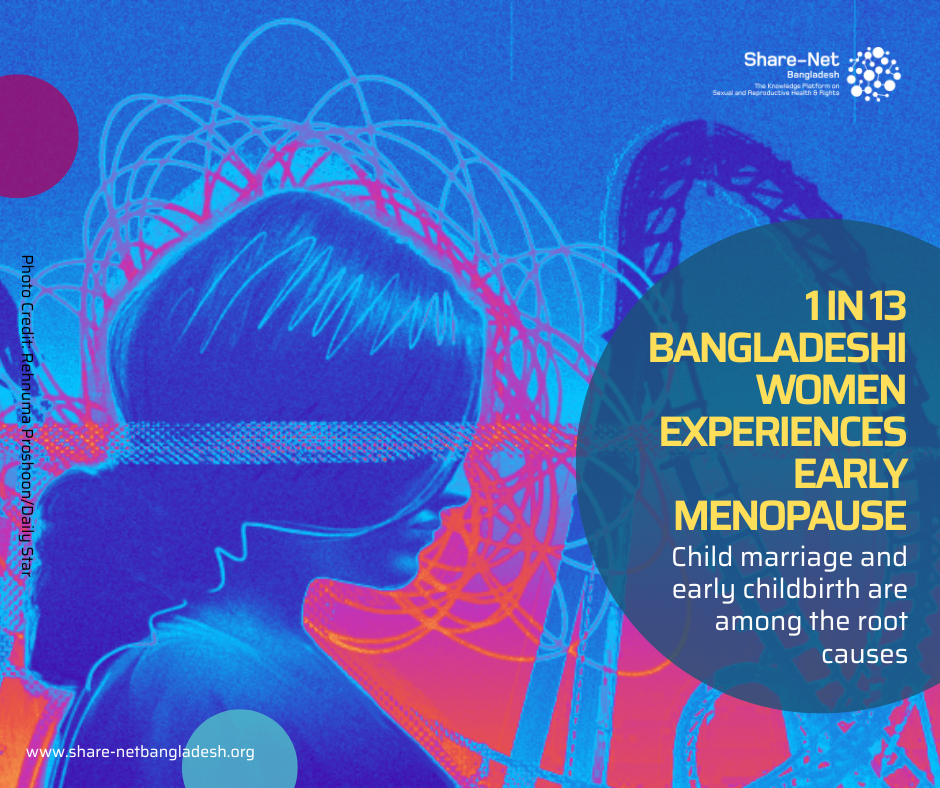
1 in 13 Bangladeshi Women Experiences Early Menopause: Child Marriage and Early Childbirth Are Among the Root Causes
A landmark study led by researchers at icddr,b and published in BMJ Global Health has found that around one in every 13 Bangladeshi women experiences menopause before the age of 45. The research analysed health data from 716,648 women across 44 low and middle-income countries, making it the largest study of its kind.
Menopause is often treated as a private milestone that marks the end of a woman’s reproductive years. Yet, a new study suggests it tells a much bigger story about education, gender equality, healthcare, and the lifelong impact of social inequalities. In Bangladesh, where conversations around women’s health still largely focus on pregnancy and childbirth, early menopause is emerging as another critical Sexual and Reproductive Health and Rights (SRHR) issue that deserves national attention.
Bangladesh recorded an early menopause prevalence of 7.5 percent, slightly higher than the overall average of 7.1 percent across low and middle-income countries. Within South Asia, the country’s rate is close to Nepal (7.9 percent) and India (8.0 percent), while Pakistan reported a lower prevalence of 5.9 percent.
Although menopause is a natural biological process that typically occurs between the ages of 45 and 55, menopause before age 45 is considered early. Women who experience it lose the protective effects of oestrogen much sooner, increasing their lifetime risk of cardiovascular disease, osteoporosis, cognitive decline, and depression.
However, the study’s most important finding is that biology alone does not explain early menopause.
“Our findings show that premature or early menopause is shaped by much more than biology,” said lead researcher Raisha Binte Islam of icddr,b. She noted that women with less education, those living in rural communities, and those who married or gave birth at younger ages consistently experienced a greater burden.
The research identified several social determinants closely linked to early menopause. Women living in rural areas were 17 percent more likely to experience menopause before age 45, even after accounting for wealth, education, employment, and reproductive history. Education emerged as one of the strongest protective factors. Compared with women who had no formal education, those with secondary education had significantly lower odds of early menopause, while higher education reduced the risk by more than half.
The findings also strengthen the growing body of evidence linking child marriage and early childbirth to long-term reproductive health consequences. Women who married and had their first child after the age of 18 were significantly less likely to experience early menopause.
For Bangladesh, these findings extend beyond reproductive health. They reinforce why preventing child marriage, keeping girls in school, and ensuring equitable access to quality healthcare are essential investments for women’s lifelong wellbeing.
Anisur Rahman, Senior Director of the Maternal and Child Health Division at icddr,b, urged policymakers to recognise early menopause as “an important marker of women’s future health, not simply a reproductive milestone.”
The study also recommends integrating menopause history into routine healthcare, expanding access to reproductive health services, investing in girls’ education, and strengthening efforts to eliminate child marriage.
As Bangladesh continues advancing its SRHR agenda, this research delivers a timely reminder that women’s health does not end with motherhood. Every stage of life deserves equal attention, evidence-based care, and informed public dialogue. Sometimes, the most important health stories begin long before symptoms appear, and continue long after reproductive years have ended.
