
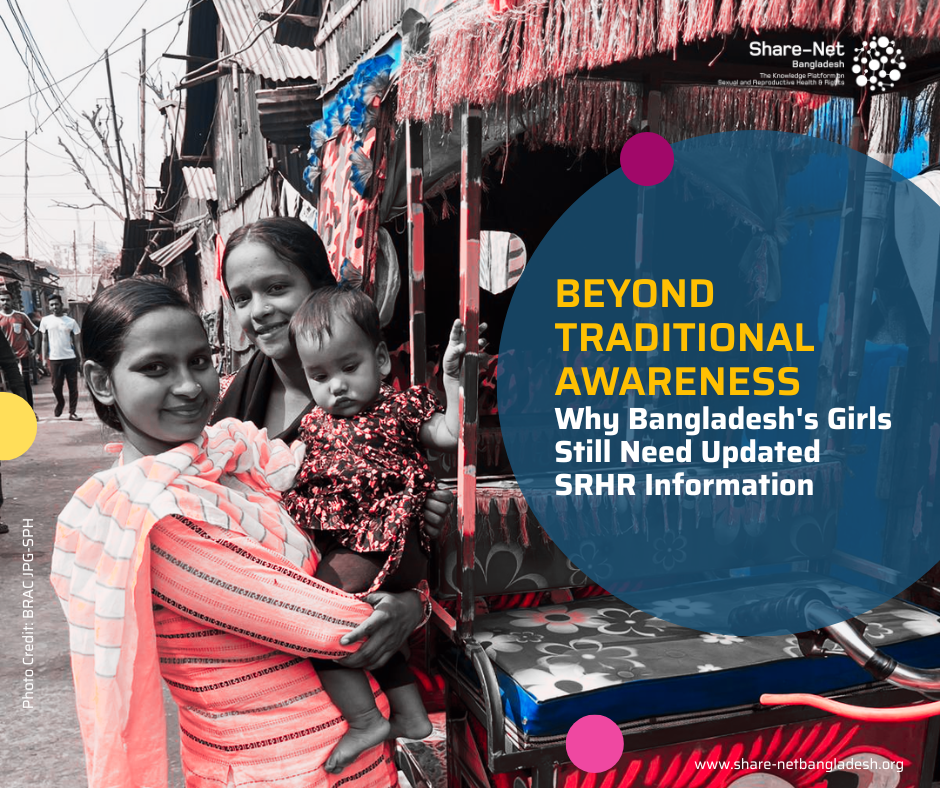
Beyond Traditional Awareness: Why Bangladesh’s Girls Still Need Updated SRHR Information
Knowledge can change a life. Yet for millions of adolescent girls in Bangladesh, one of the most important conversations about their bodies, health, and rights still begins far too late, if it begins at all. While the country has made remarkable progress in reducing maternal mortality and expanding healthcare services, access to accurate Sexual and Reproductive Health and Rights (SRHR) information remains deeply unequal. For girls living in urban slums, the silence around SRHR is not simply uncomfortable. It is a public health challenge with lifelong consequences.
Eighteen-year-old Sumi’s story captures this reality. Married, already a mother, and living in an urban settlement in Dhaka, she had never heard the term “Sexual and Reproductive Health and Rights” until researchers introduced it to her. Her experience is not unusual. As one researcher observed, “These girls are not on the margins of reproductive life. They are at its centre, without a map.”
Despite years of national commitments, many adolescent girls continue to enter marriage and motherhood without understanding contraception, consent, menstrual health, or their reproductive rights. According to the latest available national estimates from UNICEF and UNFPA, Bangladesh continues to have one of the highest child marriage rates in Asia. More than half of women aged 20 to 24 were married before turning 18, while adolescent pregnancy remains a major concern, particularly among disadvantaged communities. Recent UN reports in 2026 also warn that economic shocks, climate displacement, and urban poverty continue to increase the vulnerability of adolescent girls to early marriage and school dropout.
The policy framework already exists. Bangladesh’s National Adolescent Health Strategy 2017 to 2030 and national education policies recognise the importance of adolescent reproductive health education. However, implementation remains inconsistent. In many schools, SRHR lessons are skipped because teachers feel uncomfortable discussing subjects such as puberty, contraception, consent, or gender equality. For girls who leave school early because of marriage, poverty, or child labour, even this limited education never arrives.
Urban slums expose these inequalities even more clearly. Research continues to show that many married adolescent girls are unable to make informed decisions about their own reproductive health. Limited access to youth-friendly healthcare, social stigma, and misinformation often leave them without reliable support during one of the most vulnerable periods of their lives.
Digital platforms are beginning to bridge some of these gaps. Bangladesh’s rapid growth in smartphone ownership has created new opportunities for confidential SRHR education through digital health services, mobile applications, and educational videos. Platforms offering anonymous counselling demonstrate that young people are actively seeking trustworthy information when safe spaces become available. Yet digital inclusion remains uneven. Many girls still rely on shared mobile phones, face restrictions on internet use, or struggle to find content that reflects their own realities.
Experts increasingly argue that digital SRHR education must move beyond simply publishing information online. Content should be co-created with adolescents from low-income communities, designed in simple language, and distributed through channels that young girls can actually access. At the same time, stronger collaboration between the Ministry of Health and Family Welfare, the Ministry of Education, local governments, and civil society organisations is essential to reach girls who remain outside both schools and formal healthcare systems.
Bangladesh has demonstrated that policy reforms can improve health outcomes. The next challenge is ensuring that knowledge reaches every girl before life-changing decisions are made for her. Because reproductive rights begin with information, and information remains one of the strongest forms of protection.
No girl should have to learn about her rights only after those rights have already been denied.