
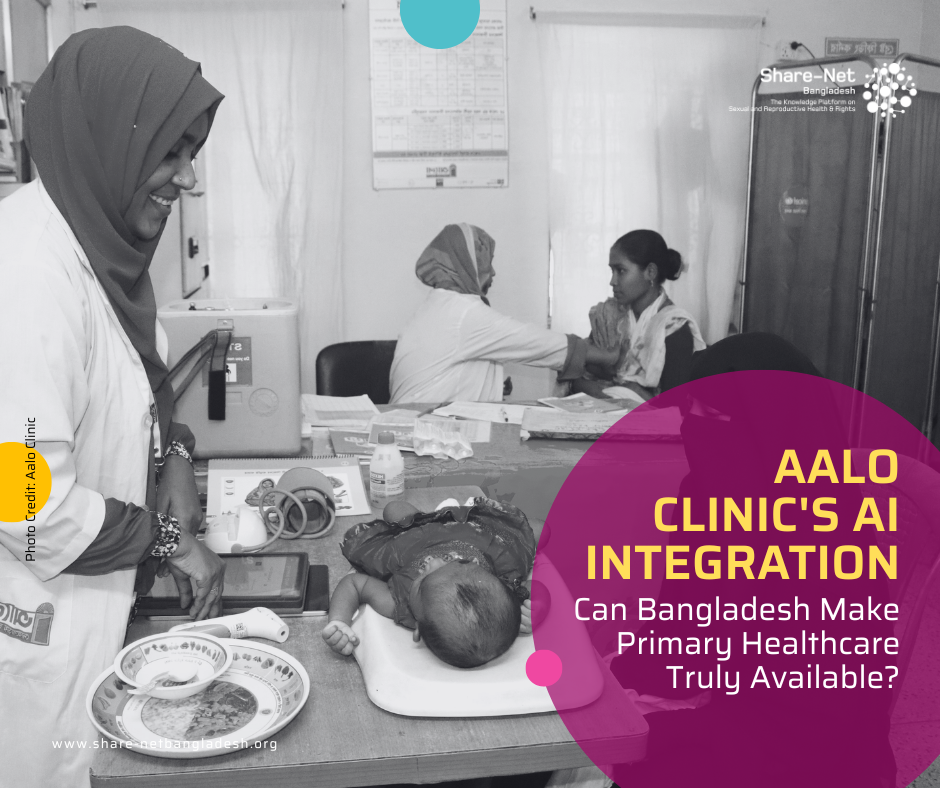
Aalo Clinic’s AI Integration: Can Bangladesh Make Primary Healthcare Truly Available?
What if a routine health check could prevent a hospital visit months later? And what if that check happened not in a large hospital, but in a neighbourhood clinic or through a trained community health worker?
That question sits at the heart of Bangladesh’s growing interest in technology-enabled primary healthcare. The discussion gained fresh momentum at the National Experience Sharing Workshop on the Aalo Clinic model, held on 9 July 2026, organised by the Directorate General of Health Services with support from UNICEF. The workshop brought field experience and evidence from urban primary healthcare into a wider policy conversation.
The Aalo Clinic experience is important because Bangladesh’s urban population is growing faster than its primary healthcare system can comfortably absorb. A 2026 study published in PLOS ONE found that the Aalo Clinic model was designed to address gaps in affordable primary healthcare for underserved urban communities, while also identifying challenges that need attention before such models are scaled up.
The wider iGP model described in recent discussions takes the idea further. It combines community health workers, digital health records, point-of-care diagnostics and AI-supported clinical decision-making. Its stated ambition is simple: identify health risks earlier and connect people to the right level of care before conditions become emergencies.
For sexual and reproductive health and rights (SRHR), that shift could be particularly significant.
Primary healthcare is often the first place where adolescents, pregnant women and young couples can seek information and services on contraception, maternal health, menstrual health, STI prevention and gender-based violence referrals. Bangladesh still faces serious gaps. UNFPA reports that 24 percent of girls aged 15-19 had either given birth or were pregnant with their first child in 2022, while unmet need for family planning among married adolescent girls stood at 12.7 percent.
A technology-enabled primary care system could therefore make screening, counselling and referral more regular. It could also help health workers follow up with patients rather than treating every consultation as an isolated event.
But AI is not a shortcut around weak health systems.
The World Health Organization has repeatedly warned that AI can improve access and support health workers, but only when backed by strong governance, privacy protection, regulation, equity and human oversight.
That warning matters for SRHR. Digital records containing reproductive health information are highly sensitive. Adolescents and survivors of violence need confidentiality, not simply connectivity. Algorithms also need to work fairly across gender, age, income and geography.
The strongest lesson from the Aalo Clinic discussion, therefore, may not be that Bangladesh needs more AI. It is that Bangladesh needs better-connected primary healthcare, with technology serving people and health workers rather than replacing them.
The future of healthcare should be “proactive rather than reactive”. For Bangladesh, the real test will be whether that principle can reach the people who are still least likely to receive timely, respectful and affordable care.