
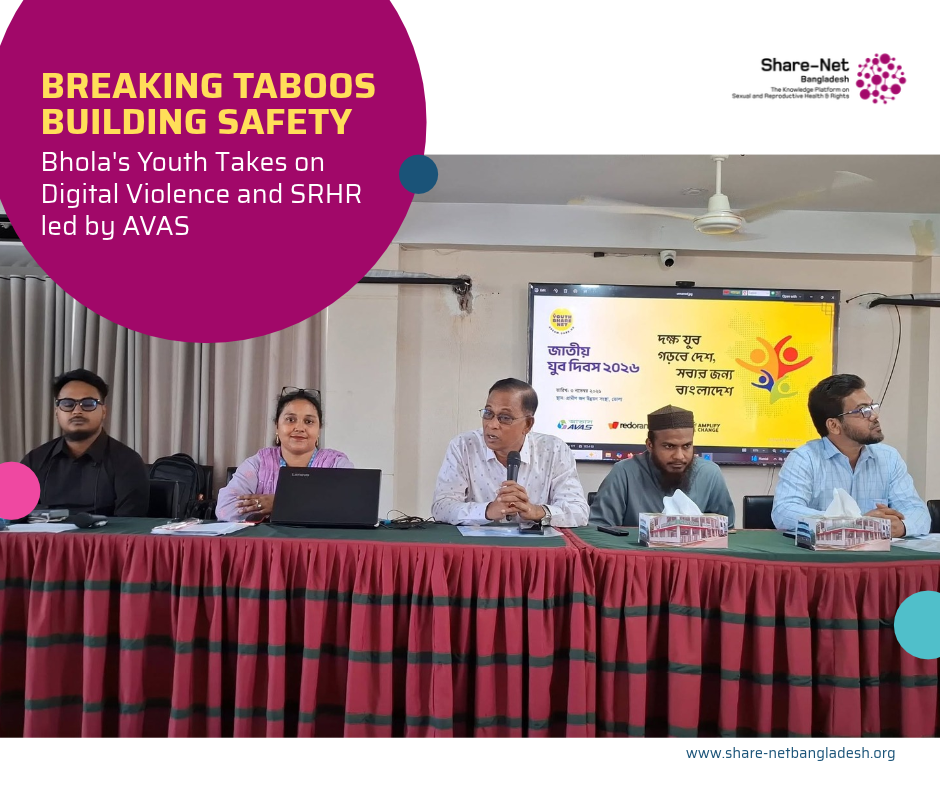
Breaking Taboos, Building Safety: Bhola’s Youth Takes on Digital Violence and SRHR led by AVAS
Sexual and reproductive health is often discussed in terms of healthcare facilities, family planning, menstrual hygiene and adolescent pregnancy. But for young people today, the challenges extend far beyond the physical world. Online harassment, cyberbullying, image-based abuse and violations of digital privacy increasingly shape their safety, dignity and ability to exercise their rights.
Recognising this connection, a local initiative in Bhola brought youth rights, gender equality, sexual and reproductive health and digital safety into the same conversation on November 3, 2026, marking National Youth Day.
Organised by RedOrange under the Youth Share-Net project, the discussion was held at the training room of Grameen Jano Unnayan Sangstha in Bhola Sadar. The Association of Voluntary Actions for Society (AVAS) implemented the activity with support from AmplifyChange. Titled Establishing a Localised Youth and SRHR Network through the Celebration of National Youth Day 2026, the event brought together youth representatives, volunteers, journalists and government and civil society representatives.
Discussions covered adolescent health, menstrual hygiene management, personal hygiene, safe sanitation, child marriage and adolescent pregnancy. Participants also highlighted the persistent social stigma and misinformation surrounding reproductive health, calling for age-appropriate, science-based information and accessible, youth-friendly health services.
However, digital safety emerged as a particularly important dimension of the discussion. Technology-facilitated gender-based violence, including cyberstalking, online harassment, cyberbullying, image-based abuse and online blackmail, was identified as a growing concern, particularly for adolescent girls and young women. Participants stressed the importance of digital privacy, consent, personal data protection and access to support for survivors.
The concern is supported by national evidence. The Bangladesh Bureau of Statistics (BBS) and UNFPA’s Violence Against Women Survey 2024, published in October 2025, found that 8.3% of women had experienced technology-facilitated gender-based violence in their lifetime, while 5.2% experienced it in the preceding year. The findings underline why digital safety must be treated as part of gender equality and rights protection, rather than simply a matter of responsible internet use.
The broader SRHR situation also demands attention. World Bank data based on United Nations population estimates put Bangladesh’s adolescent fertility rate at approximately 71 births per 1,000 girls aged 15–19 in 2024.
The discussion also included Md. Farid Uddin, Assistant Director of the Department of Youth Development, Bhola, and Md. Jamal Uddin, Bhola Upazila Family Planning Officer, as special guests.
Beyond the discussions, the initiative placed emphasis on establishing an inclusive local youth and SRHR network to facilitate regular communication, knowledge-sharing and joint awareness activities.