
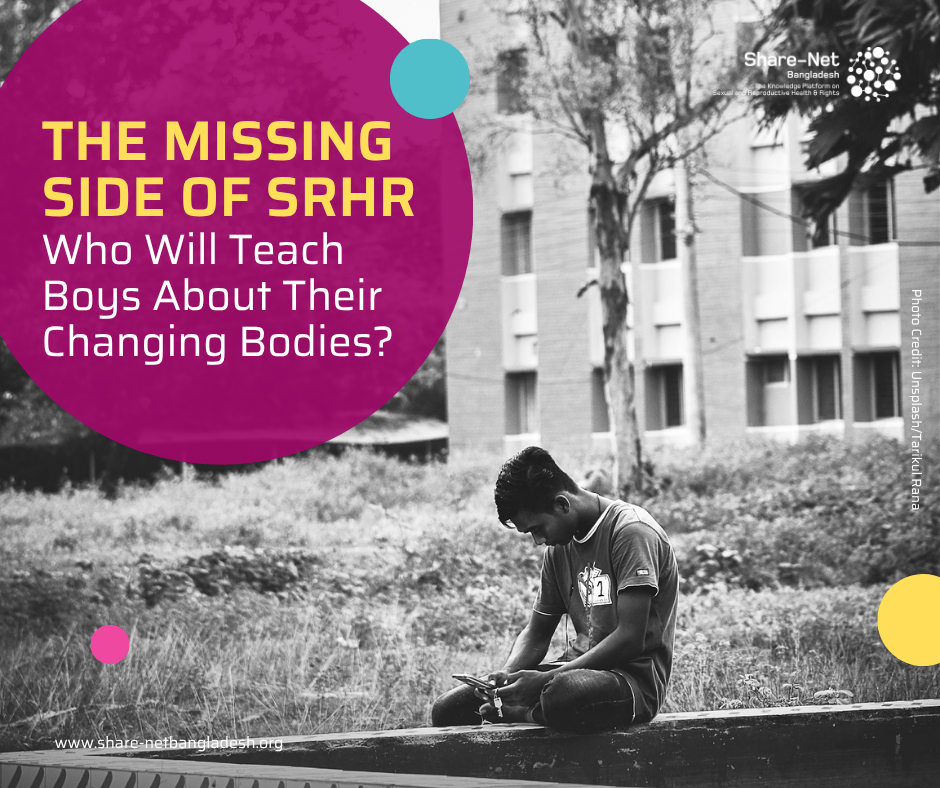
The Missing Side of SRHR: Who Teaches Boys About Their Changing Bodies?
For many boys, growing up comes with questions that are rarely asked aloud. Why is the body changing? Is a particular change normal? Who can they ask without being laughed at? And as they grow older, where do they learn about consent, boundaries, respectful relationships, and sexual health? Too often, the answer is nowhere formal.
Research from Bangladesh has repeatedly pointed to gaps in how boys receive information about puberty and sexual and reproductive health. A 2022 study of 2,724 school-going adolescents in rural Bangladesh found that age, years of schooling, and teacher involvement were associated with better knowledge of pubertal changes. The study also found that male adolescents had poorer understanding of puberty than female adolescents.
A nationwide study of more than 11,000 young Bangladeshi males aged 15 to 24, conducted as part of research into male SRHR, examined knowledge, attitudes, health-seeking behaviour, puberty, sexuality, masculinity, and family relationships. The scale of that research itself points to a longstanding evidence gap: adolescent boys and young men have often received less attention in SRHR research than girls and young women.
There is a practical reason to take boys seriously in SRHR education. Boys are not simply observers of issues such as child marriage, adolescent pregnancy, or gender-based violence. Their understanding of consent, equality, contraception, healthy relationships, and bodily autonomy can influence the social environments in which everyone grows up.
But education needs to go beyond biological facts. A study exploring the experiences of nine Bangladeshi young men found that parents often remained silent about sexuality, while peers became important sources of information. The researchers described the information boys received as sometimes incomplete, unreliable, and shaped by gender expectations.
This is where comprehensive sexuality education can make a difference. WHO says age-appropriate education should cover human development and puberty alongside relationships, consent, bodily autonomy, gender equality, safety, contraception, STIs and access to health services. Evidence reviewed by WHO also finds that quality sexuality education improves knowledge and does not increase sexual activity or encourage earlier sexual behaviour.
Bangladesh also has evidence that structured interventions can improve what boys know. A 2025 study of 234 male adolescents found that participants exposed to the Gender Equity Movement in Schools had substantially higher knowledge of gender issues, although the researchers noted that improved knowledge did not automatically translate into more gender-equitable attitudes. Family influences remained important. That distinction is crucial. Because knowing is not the same as changing.
If boys are left to learn these lessons alone, society should not be surprised when myths become their teachers.
