
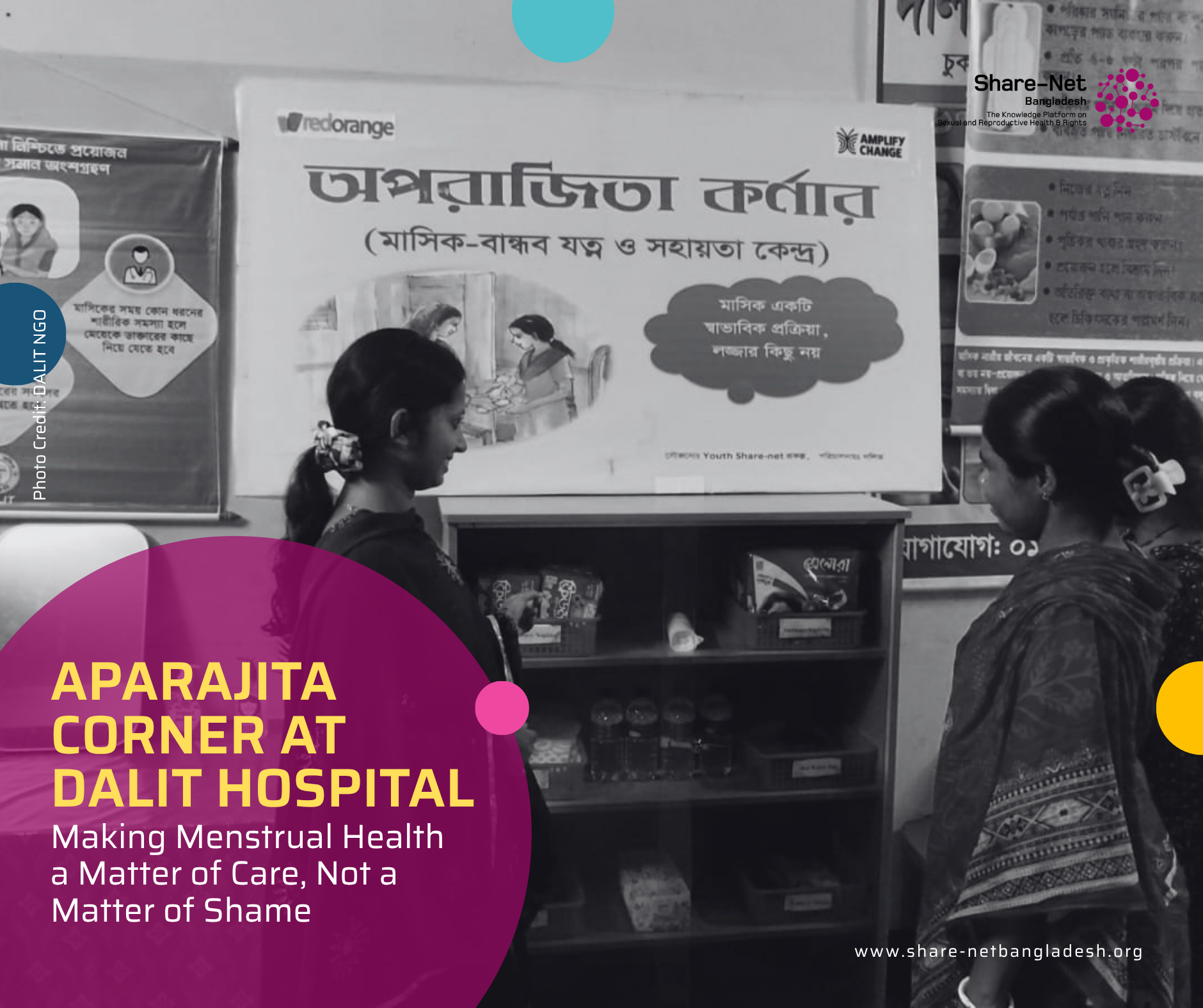
Aparajita Corner at DALIT Hospital: Making Menstrual Health a Matter of Care, Not a Matter of Shame
For many girls, the first period does not always come with a conversation, a clear explanation or a safe place to ask questions. It can arrive with confusion, embarrassment and fear. In Bangladesh, menstruation remains surrounded by silence and misinformation, even as millions of women and girls manage it every month.
That is why a small space inside a hospital can carry a much bigger message.
At DALIT Hospital in Chuknagar, the “Aparajita Corner: Menstrual Health Care and Support Centre” has been established to give adolescent girls and women a safe and supportive place to learn about menstrual health, seek guidance and access essential menstrual hygiene products. The initiative is implemented by DALIT under the Youth Share-Net project, with funding from AmplifyChange and support from RedOrange.
The idea is simple but important: menstrual health should be treated as a health and rights issue, not as something to hide.
The numbers show why it matters
Bangladesh has made progress, but significant gaps remain. The latest Bangladesh Multiple Indicator Cluster Survey (MICS) 2025, conducted by the Bangladesh Bureau of Statistics with UNICEF, found that 85.1% of women aged 15 to 49 had sufficient menstrual materials during their last period, while 83.2% could change their menstrual materials in privacy at home. Yet only 30.8% knew about menstruation before their first period.
The gap becomes even more visible when participation is considered. MICS 2025 found that 27.3% of women aged 15 to 19 did not participate in school, work or social activities during their last menstruation. At the national level, 27.3% of women aged 15 to 49 reported missing such activities during their last period.
These figures show that menstrual health is about much more than access to sanitary products. Girls also need accurate information, privacy, supportive services and an environment where they can ask questions without fear of judgement.
UNICEF has also highlighted how stigma and misinformation continue to shape menstrual experiences in Bangladesh. Its 2025 review noted that many girls still encounter restrictions around cooking, schooling, social interaction and discussing menstruation.
Why Aparajita Corner matters
Aparajita Corner responds to several of these needs in one place. Information, counselling, awareness and menstrual hygiene supplies can help girls understand their bodies and manage menstruation with greater confidence.
More importantly, such a space can help shift the conversation from “hygiene” to “health and dignity.”
That distinction matters. A girl who knows what menstruation is before her first period is better prepared. A girl who can ask a health worker a question without embarrassment has greater access to reliable information. And a health facility that openly addresses menstruation sends a message that there is nothing shameful about a normal biological process.
Initiatives like Aparajita Corner therefore deserve recognition, learning and expansion. Hospitals, schools, community clinics and youth centres across Bangladesh can create similar safe spaces, particularly in communities where information and services remain limited.
Menstruation is not a problem girls need to hide. It is a normal part of health that society needs to understand.
Aparajita Corner’s strongest message may be its simplest one: menstrual health is not a luxury. It is a right.