
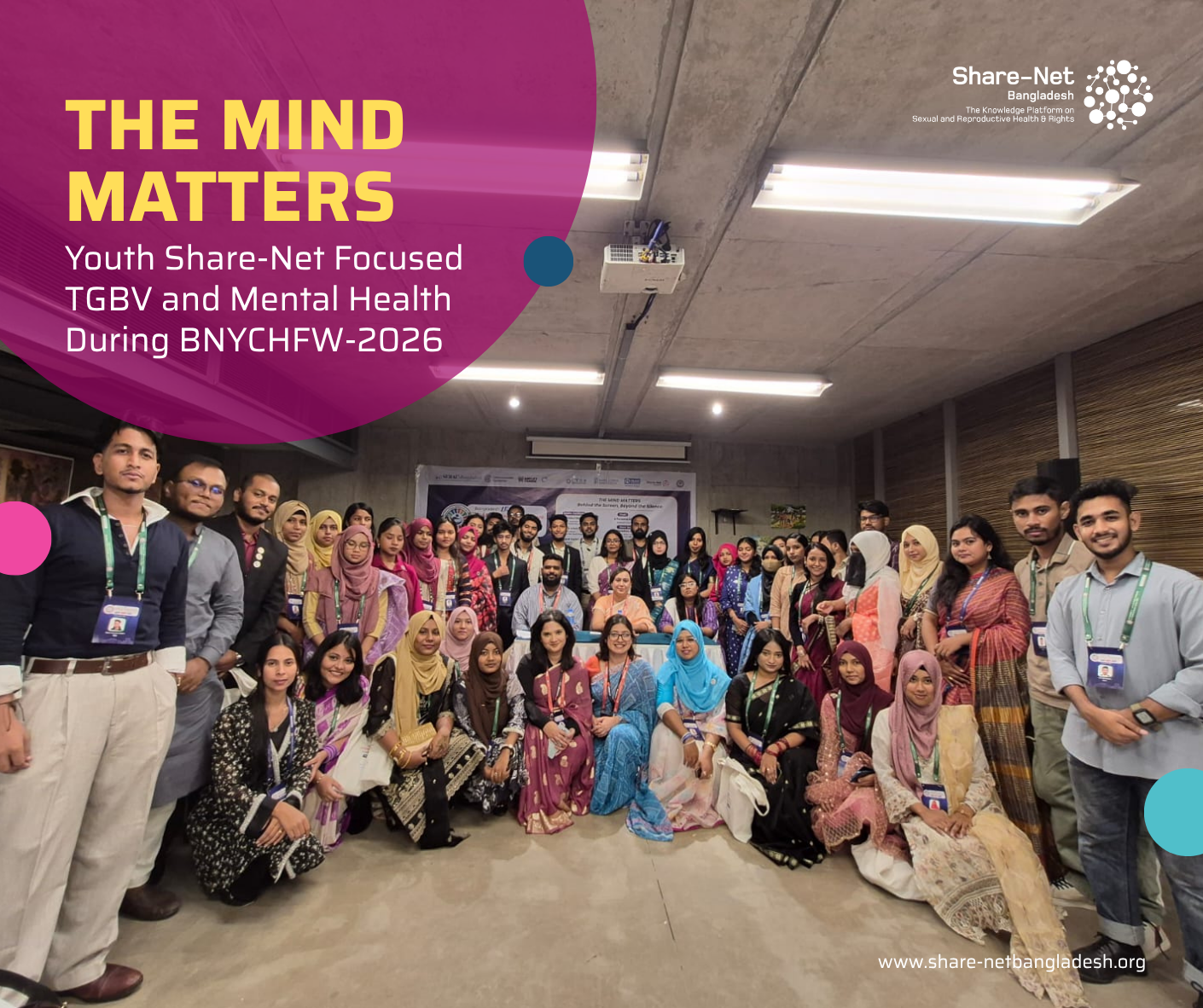
The Mind Matters: Youth Share-Net Focused TGBV and Mental Health During BNYCHFW-2026
If young people cannot speak about online harm without fear of blame, how can they seek help? And can Bangladesh advance youth-friendly healthcare without treating digital safety, mental wellbeing and SRHR as connected priorities?
These concerns took centre stage on October 14 at the 11th Bangladesh National Youth Conference on Health and Family Welfare 2026 (BNYCHFW-2026), organised by SERAC-Bangladesh at the Liberation War Museum in Dhaka. The conference broadened its traditional family planning focus to address young people’s wider health and mental wellbeing, under the theme “Create. Connect. Catalyze.”
The opening dialogue of the BNYCHFW-2026, titled “From Youth Population to Youth Power: Shaping Bangladesh’s Health Future,” brought youth priorities into discussions on health policy, inclusive services and youth leadership. The session featured Prof. Dr. M A Muhit, Hon’ble State Minister, Ministry of Health and Family Welfare (MoHFW), as the Chief Guest, and A K M Benjamin Riazi, Secretary, Medical Education and Family Welfare Division, MoHFW, as the Special Guest. The dialogue was organised by SERAC-Bangladesh in collaboration with the Commonwealth Foundation.
The second plenary session, “Our Health, Our Rights: Making Youth-Friendly Care a Reality,” featured Khaleda Yasmin, Director, Health & Gender, RedOrange, alongside Dr. ASM Amjad Hossain, Associate Director of EASD; and Prof. Dr. Kamal Uddin Ahmed Chowdhury, Professor, Department of Clinical Psychology, Dhaka University. The session was chaired by Prof. Dr. Md. Anower Hussain, Chairman, Department of Public Health, State University of Bangladesh.
Under the Youth Share-Net Project, RedOrange also organised the parallel session “The Mind Matters: Behind the Screen, Beyond the Silence,” creating space to discuss digital pressures, stigma and young people’s mental health. The session featured Christina Arpa Gomes, NYCPD-SRHR, DGFP, and Montaher Arafat, President of Youth Action for Development (YAD). Farzana Ahmed, Asst. Clinical Psychologist, chaired the session, while the Youth Share-Net Team facilitated the discussion. The session explored how peers, families and support services can help young people seek mental health support without fear or judgement.
The discussion reflects a wider public health concern. The World Health Organization (WHO) estimates that one in seven people aged 10 to 19 globally experiences a mental health condition. Violence, bullying, social exclusion and stigma can increase adolescents’ vulnerability, while fear of disclosure can prevent them from seeking help.
Bangladesh’s national evidence highlights the scale of the digital safety challenge. The Bangladesh Bureau of Statistics and UNFPA’s Violence Against Women Survey 2024 found that 8.3% of women surveyed had experienced selected forms of technology-facilitated gender-based violence during their lifetime, while 5.2% reported such experiences in the previous year. The report cautions that these measures cover selected acts and do not capture the full spectrum of digital abuse.
The challenge now is to turn discussion into accessible support. Schools, families, digital platforms and healthcare providers need clear reporting pathways, confidential and respectful services, and better awareness of how digital abuse affects mental health and SRHR. Young people should also help shape the responses intended for them.