
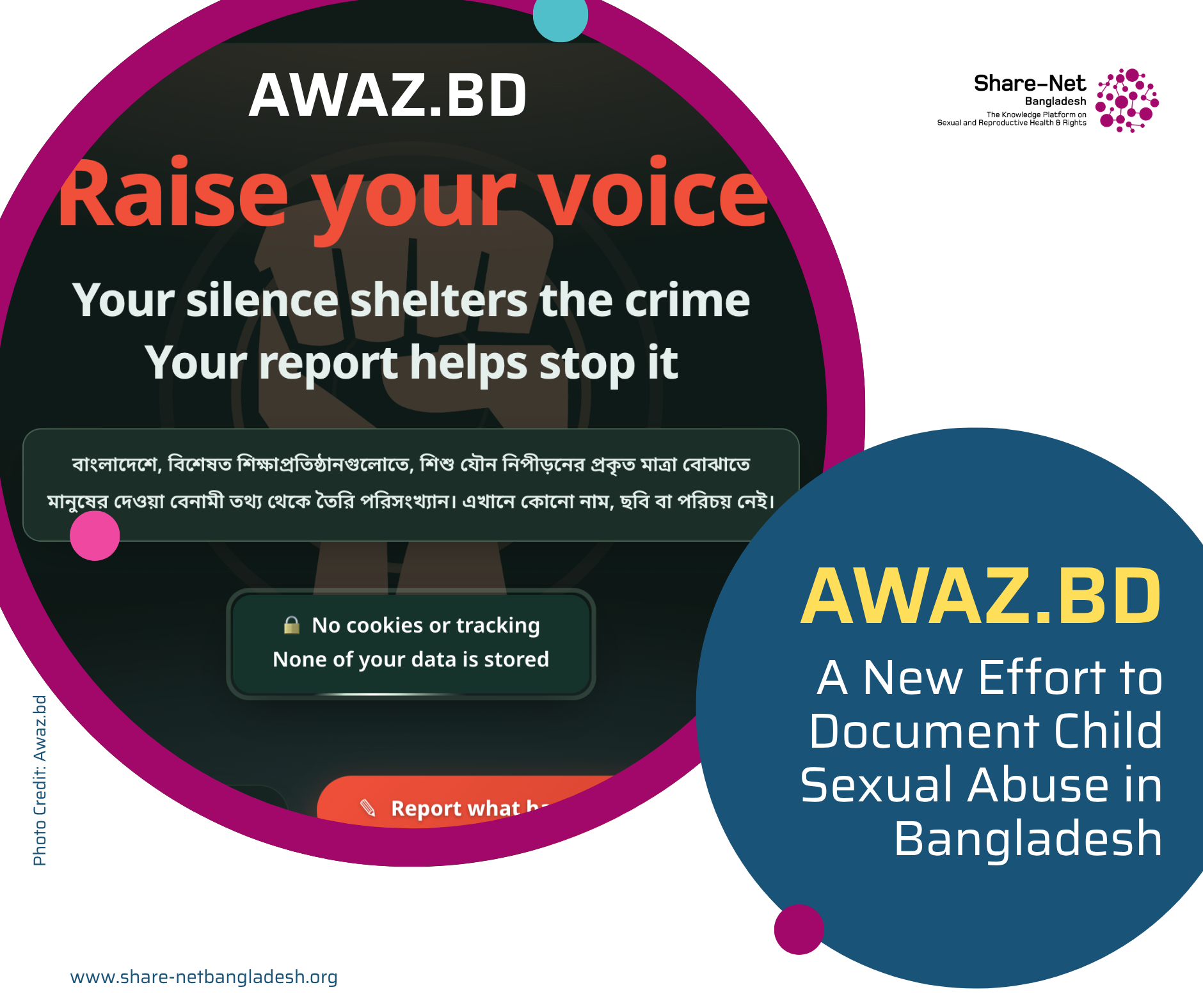
Someone Is Here To Listen: Awaz.bd’s New Effort to Document Child Sexual Abuse in Bangladesh
What happens when a child experiences sexual abuse but has no safe place to speak? Fear, shame, family pressure and uncertainty often keep these experiences hidden. As a result, police records, court cases and news reports capture only a fraction of the abuse taking place in homes, schools and other closed environments.
A newly launched website, awaz.bd, is attempting to make some of these hidden experiences visible. The platform allows people to anonymously document childhood sexual abuse. Instead of publishing names or identifiable accusations, it presents submissions as aggregated statistics. According to its creators, 124 accounts were submitted within 72 hours of its launch on 7 September.
The early data offer a disturbing glimpse into the environments where abuse is reported. Boys accounted for 66 submissions, or 53%, while girls accounted for 58, or 47%. Nearly half of the reported incidents—49% were linked to homes. Religious and educational institutions accounted for another 33%, while others were associated with public places, commercial spaces and transport settings.
The reports also suggest that abuse is often not an isolated event. Forty-eight percent of respondents said the abuse happened multiple times, compared with 36% who reported a one-time incident and 16% who described long-term abuse. Family members were identified in 10% of submissions overall, rising to 18% among reports involving girls.
Educational and religious institutions require particular attention. The platform separately reports that 36% of respondents experienced abuse in educational institutions. Among these accounts, Qawmi madrasahs represented 56% and schools 19%. These figures do not establish that abuse is more prevalent in any particular institution; rather they indicate where anonymous respondents said their experiences occurred and where stronger safeguarding questions must be asked.
Child sexual abuse is a violation of bodily autonomy, dignity and the right to live a safe and healthy life. Its consequences can extend far beyond childhood, affecting mental health, relationships, trust, sexual well-being and future reproductive choices. Platforms such as awaz.bd may help break the silence but visibility must lead to action: confidential healthcare, psychosocial support, survivor-centred services and stronger protection systems. An SRHR approach means not only listening to survivors, but also ensuring that every child has the right to safety, dignity and control over their own body.
Its real value, therefore, will depend on what happens next. Anonymous accounts can help break silence, identify patterns and challenge institutional denial but they cannot replace child-protection systems, survivor-centred services or credible investigations.
Making hidden experiences visible is only the beginning. The real test is whether Bangladesh’s institutions are willing to listen, respond and protect children before another generation is forced into silence.
Want to report an experience of abuse? Please visit – awaz.bd
