
Reproductive Rights Under Siege: Why Global Backlash Matters Now More Than Ever
For decades, the fight for sexual and reproductive health and rights (SRHR) has been a story of resilience – of communities pushing boundaries, women claiming autonomy, and policies slowly aligning with human dignity. But that story is now facing a sharp and coordinated reversal.
A recent statement from Women Deliver warns that reproductive rights — once considered hard-won victories — are increasingly under political and ideological attack. From abortion access to emergency contraception, progress is being challenged across regions, raising concerns about the future of SRHR globally.
At the heart of the warning is a troubling trend: a coordinated, cross-border backlash. As Paola Salwan Daher of Women Deliver noted, some countries are experiencing “significant retrogression under religious influence.” The implications go beyond national borders, shaping global narratives and policies.
A Pattern of Regression
Recent developments illustrate a worrying pattern:
- In the United States, abortion rights have faced major rollbacks following legal reversals.
- In Slovakia, repeated legislative attempts aim to restrict abortion access.
- Hungary has introduced additional barriers to contraception and family planning.
These are not isolated cases. According to the Guttmacher Institute (2024), nearly 40% of women of reproductive age live in countries with restrictive abortion laws. Meanwhile, UNFPA reports that 1 in 4 women globally cannot make decisions about their own sexual and reproductive health.
Such restrictions do more than limit services; they undermine fundamental human rights, including health, privacy, equality, and freedom from discrimination.
Beyond Health: A Democratic Concern
Advocates argue that attacks on reproductive rights often signal broader democratic backsliding. When states control bodily autonomy, it reflects deeper issues of governance, accountability, and human rights protections.
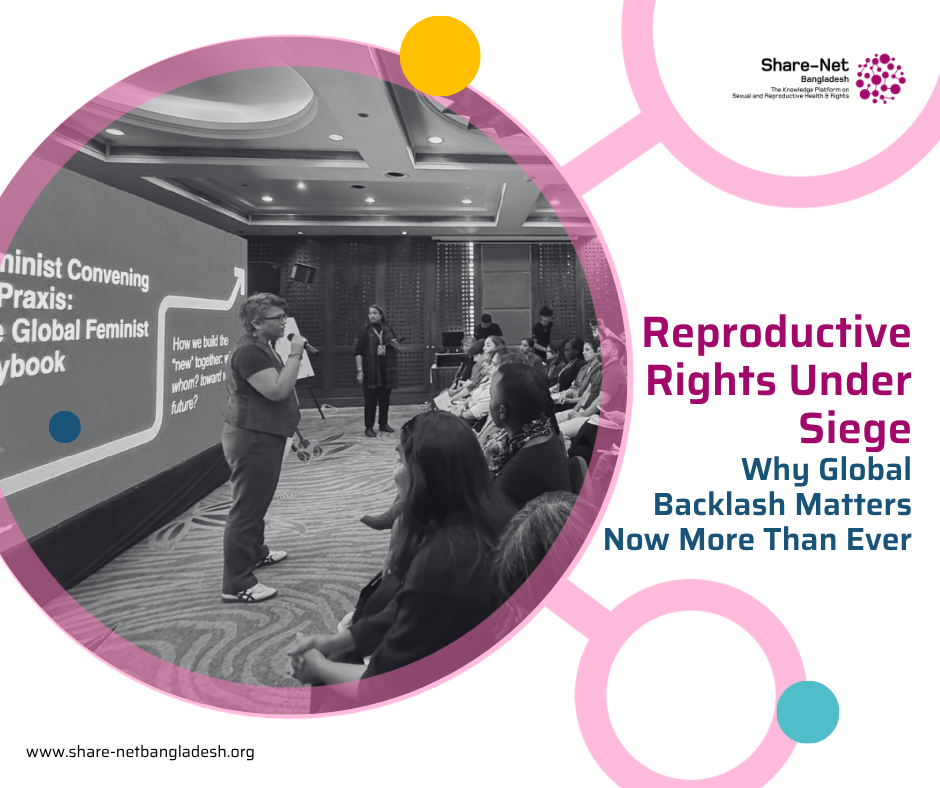
This growing concern is shaping global conversations ahead of the Women Deliver 2026 Conference in Melbourne, where stakeholders will launch the Feminist Playbook, a roadmap designed to strengthen solidarity and collective action.
The emphasis is clear: fragmented efforts are no longer enough. In a world where opposition movements are well-funded and coordinated, SRHR advocacy must also evolve.
Why It Matters for Bangladesh
While Bangladesh has made notable progress in family planning and maternal health, global trends cannot be ignored. Policy shifts elsewhere often influence funding, narratives, and advocacy priorities in developing countries.
For youth, especially, the stakes are high. Access to accurate information, contraception, and safe services remains uneven. Any global rollback risks widening these gaps.
A Critical Moment for Action
This is not just a policy debate; it is a defining moment for rights, dignity, and equality. The current backlash may be strong, but history shows that SRHR movements thrive on resistance and reinvention.
The question now is not whether the movement will respond but how effectively it can rebuild alliances, amplify voices, and defend the right to choose.
Because when reproductive rights are under siege, the consequences are never limited to one country; they ripple across the world.