
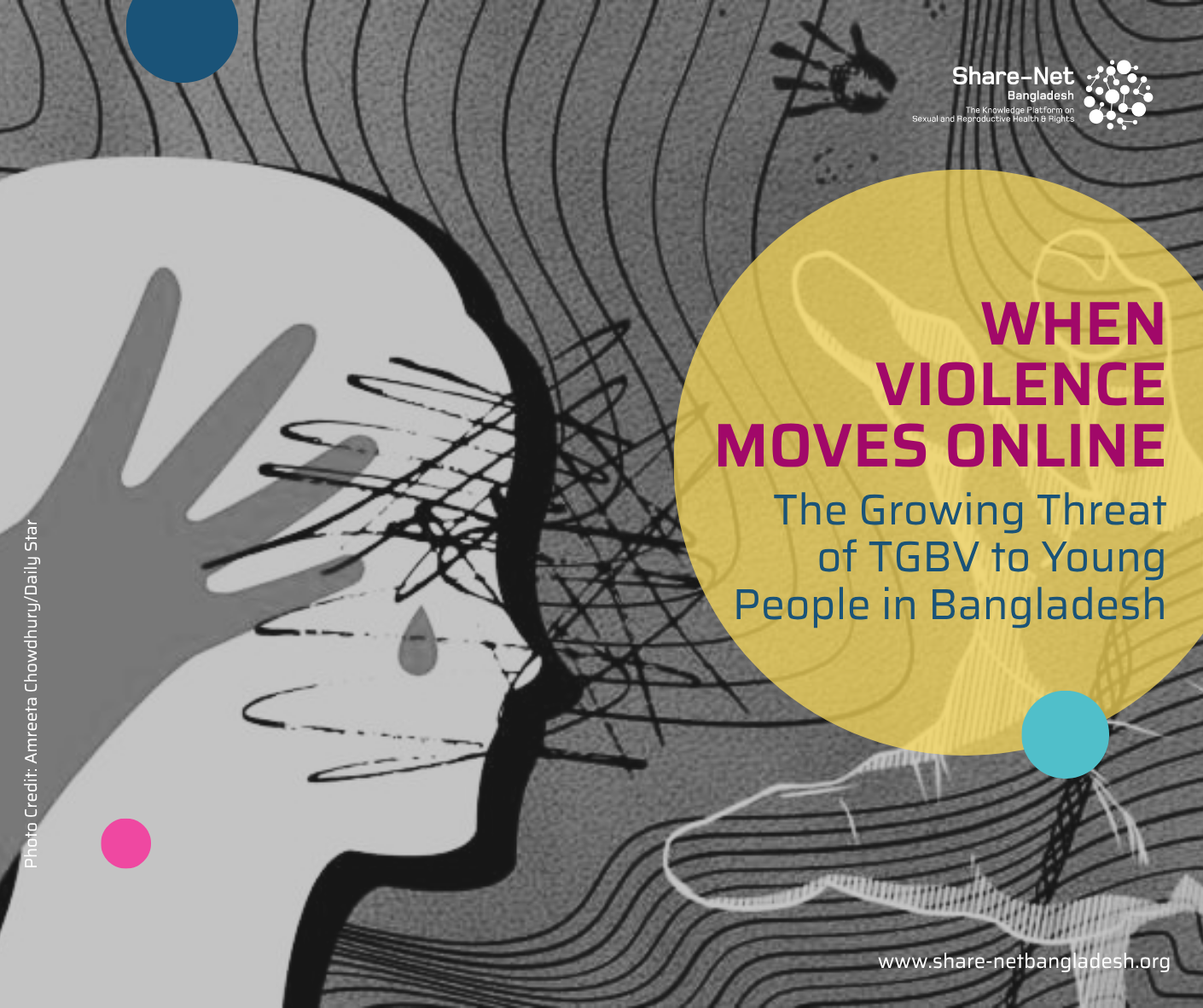
When Violence Moves Online: The Growing Threat of TGBV to Young People in Bangladesh
What happens when the violence people fear outside their homes can also reach them through a screen? As digital platforms become part of everyday life, technology is increasingly being used to harass, threaten, control and sexually exploit women and girls. In Bangladesh, Technology-Facilitated Gender-Based Violence (TGBV) is emerging as a serious threat to safety, dignity and rights.
The Bangladesh Bureau of Statistics (BBS) and UNFPA Violence Against Women Survey 2024, published in 2025, found that 8.3% of women with technology access had experienced selected forms of TGBV during their lifetime, while 5.2% experienced it in the previous 12 months. Among women aged 20–24, the figure rose to 16%, making young women the group reporting the highest prevalence. The survey measured forms including unwanted sexual communications, sexual blackmail, image-based abuse and technology-facilitated controlling behaviour.
For young people, the risks extend beyond individual online interactions. Social media and digital platforms are increasingly spaces for education, employment, relationships, self-expression and participation in public life. When threats, sexual harassment, blackmail, impersonation, stalking or manipulated images enter these spaces, young women may feel pressured to silence themselves, withdraw from online participation or change how they engage with the world.
Recent 2026 UN Women work in Bangladesh has also highlighted the scale of online harassment faced by women. An unpublished study cited by UN Women found that 66% of participating women had received explicit or threatening messages on social media. The initiative also highlights newer forms of abuse, including trolling, deepfakes and online intimidation.
TGBV is therefore not simply a technology problem. It is an SRHR issue. Sexual and reproductive health and rights include the rights to privacy, bodily autonomy, dignity, safety and freedom from violence. Non-consensual sexual content, sexual threats and digital control can undermine these rights and create consequences that extend beyond the online world.
Bangladesh is also confronting new challenges as technology evolves. In June 2026, the government began work on amendments addressing AI-generated deceptive content and online harassment, including concerns affecting women and children.
But laws alone cannot create safety.
Young people need accurate digital and SRHR information, accessible reporting mechanisms, confidential support and survivor-centred services. Protecting people online is ultimately about protecting their rights offline too. A digital Bangladesh cannot be truly inclusive if young people must sacrifice their privacy, dignity or autonomy to participate in it.
A safer digital Bangladesh therefore requires more than stronger technology. It requires stronger protection of rights. Young people need accurate information, digital literacy, confidential support and survivor-centred services so that technology can remain a tool for connection and opportunity—not another space where their dignity, autonomy and SRHR are violated.
Source:
