
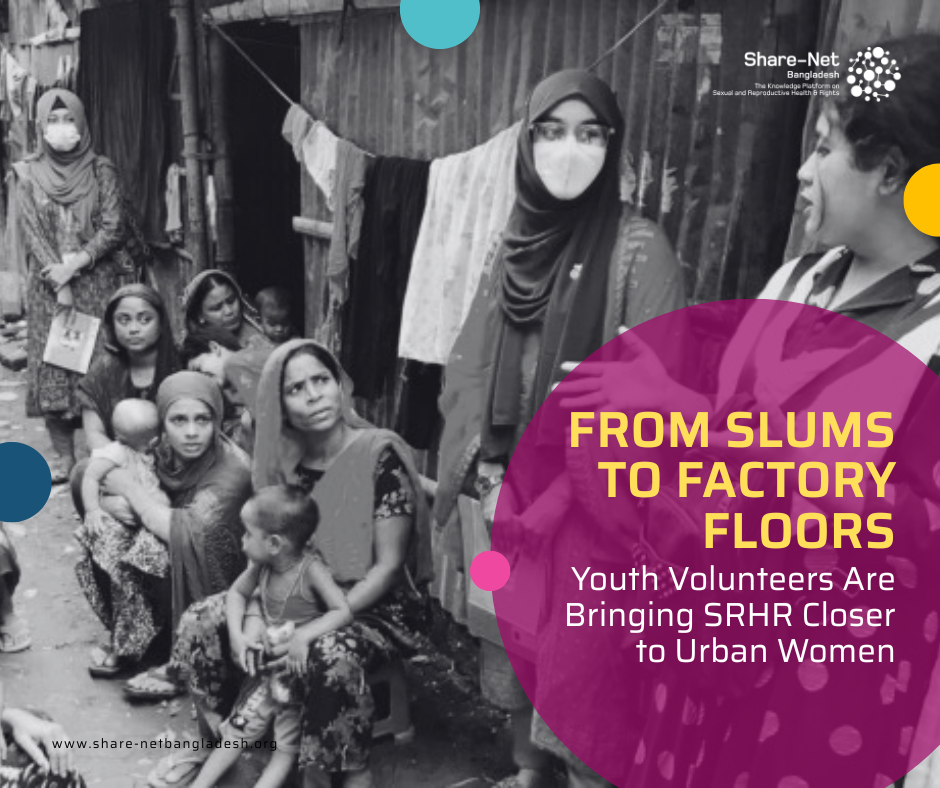
From Slums to Factory Floors: Youth Volunteers Are Bringing SRHR Closer to Urban Women
A woman working a 10-hour shift in a garment factory may know that she needs contraception. She may even know where a pharmacy is. But knowing that a service exists and being able to access reliable, confidential and affordable care are two very different things.
That gap is at the heart of the Improving Sexual and Reproductive Health and Rights in Dhaka (ISRHRD) project, which is working across low-income urban communities in Dhaka, Gazipur and Narayanganj.
The challenge is particularly important because Bangladesh’s urban population is growing rapidly, while healthcare systems have not always expanded at the same pace. Unlike rural areas, where community clinics provide a structured first point of care, access for many poor urban residents depends on a patchwork of private providers, pharmacies, NGOs and project-based services.
WHO describes primary healthcare as the “front door” of a health system. Yet for many low-income urban women, that door can still be difficult to find, afford or enter at a convenient time.
The ISRHRD project has tried a practical response: bring information and services closer to where women live and work.
According to Ipas Bangladesh, the project has strengthened SRHR services at 38 urban health centres, supported 100 GP chambers to provide quality SRHR services and worked with 15 RMG factory outpatient clinics. It has also trained 766 service providers and 296 community health workers.
Youth are another important part of the model. More than 1,500 youth volunteers and nearly 300 outreach workers have reportedly engaged more than one million community members through courtyard meetings, household discussions, street dramas and other activities.
The idea is simple but important. Information does not automatically become useful simply because it is available online or in a leaflet. Someone needs to make it understandable, trustworthy and connected to a real service.
As one youth volunteer put it, people often joke about menstruation and reproductive health. “These are normal health issues, and people should be able to discuss them without shame.”
There is strong evidence for keeping primary healthcare close to communities. WHO says accessible, people-centred primary healthcare is central to universal health coverage. Bangladesh’s new Universal Health Coverage Roadmap also highlights persistent gaps in service coverage and financial protection.
Family planning remains particularly relevant. UNFPA reports that 12% of married women in Bangladesh have an unmet need for family planning, while discontinuation of contraceptive methods remains a concern. Bangladesh launched its National Family Planning Strategy 2025-2030 in October 2025, making improved access and quality of services a national priority.
But the project also raises a difficult question: what happens when donor-funded projects end?
Project-based volunteers, trained providers and temporary service arrangements can demonstrate what is possible. The bigger test is whether these approaches can be absorbed into permanent urban health systems.
That is why the ISRHRD experience matters beyond its reported numbers. Its strongest lesson may be that urban SRHR cannot depend only on hospitals or awareness campaigns. Services need to be available where people actually live, work and make decisions about their health.
For women like Kulsum and Mariam, the real measure of success is not how many people attend a session. It is whether the next woman can get the right information, at the right time, from the right person, without fear or unnecessary barriers.
