
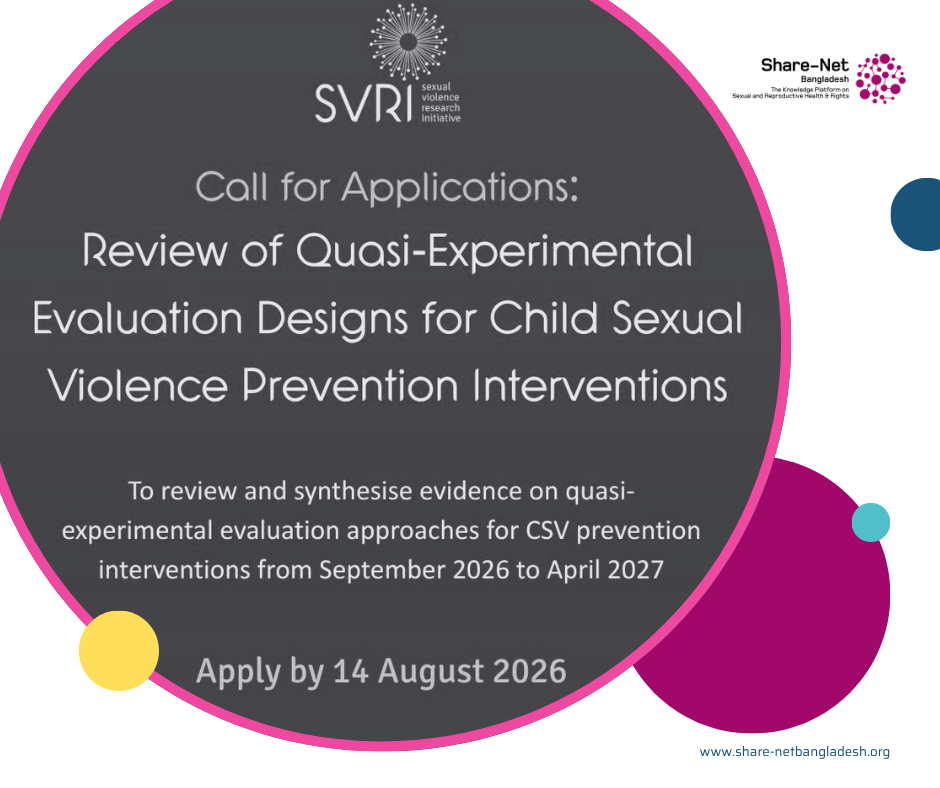
Child Sexual Violence Prevention: SVRI Calls for Evidence Review on Quasi-Experimental Research Designs
Child sexual violence (CSV) remains a major global public health and child protection issue. Although randomised controlled trials (RCTs) are widely regarded as the strongest method for evaluating interventions, they are often impractical, expensive, or ethically inappropriate in many low and middle income countries (LMICs). Recognising this challenge, the Sexual Violence Research Initiative (SVRI) seeks to commission an evidence review on quasi-experimental evaluation designs that can generate rigorous and policy-relevant evidence where randomisation is not feasible.
The assignment aims to identify practical alternatives to RCTs for evaluating CSV prevention programmes and provide evidence-based guidance for researchers, practitioners, donors, and policymakers. The review will assess which evaluation methods are most suitable under different intervention contexts while balancing scientific rigour with feasibility, affordability, ethics, and implementation realities in resource-constrained settings.
Key Objectives
- Review existing evidence on quasi-experimental evaluation methods used in CSV prevention.
- Identify promising evaluation approaches from violence prevention and related sectors.
- Assess the strengths, weaknesses, validity, and ethical implications of different research designs.
- Develop practical guidance on selecting appropriate evaluation methods for different intervention settings.
- Strengthen evidence generation where random assignment of participants is not possible.
Scope of the Review
The consultant(s) will conduct a comprehensive review of peer-reviewed and grey literature covering evaluation approaches such as:
- Matched comparison designs and propensity score matching
- Controlled before-after studies
- Interrupted time series
- Regression discontinuity
- Difference-in-differences
- Instrumental variable approaches
- Natural experiments
- Hybrid and mixed-method evaluations
- Other innovative quasi-experimental methods
The review will examine:
- Methodological rigour and causal inference
- Internal and external validity
- Ethical considerations
- Feasibility in LMICs
- Cost and resource implications
- Data availability and quality
- Ability to measure differential impacts across population groups
- Suitability for different intervention types
Purely descriptive or qualitative-only studies without a counterfactual are outside the review scope.
Expected Deliverables
The selected consultant(s) will produce:
- Inception paper with methodology and workplan
- Draft evidence review (15 to 20 pages excluding annexes)
- Practical guidance and recommendations for selecting evaluation designs
- Final evidence review incorporating stakeholder feedback
- Two to three research briefs for non-technical audiences
- Presentation slide deck summarising key findings and recommendations
Timeline
- Project Start: September 2026
- Completion: April 2027
Consultant Requirements
Applicants should have expertise in:
- Evaluation methodology
- Public health or social sciences
- Systematic or methodological reviews
- Violence prevention or child protection research
- Research in LMIC settings
- Scientific writing and knowledge translation
Collaborations involving LMIC-based researchers are strongly encouraged.
Application Requirements
Interested applicants must submit by 14 August 2026:
- A proposal (maximum 5 pages)
- Proposed methodology and review criteria
- Timeline and budget (up to USD 100,000)
- CVs of key team members
- At least two relevant work samples
- Information on LMIC partnerships (if applicable)
Applications should be emailed to svri@svri.org with the subject line:
Application – Quasi Experimental Research Designs Evidence Review
SVRI also emphasises diversity, inclusion, ethical research practices, and collaboration with researchers and institutions from LMICs.
Download Full Terms of References
For more details, please visit – SVRI
