
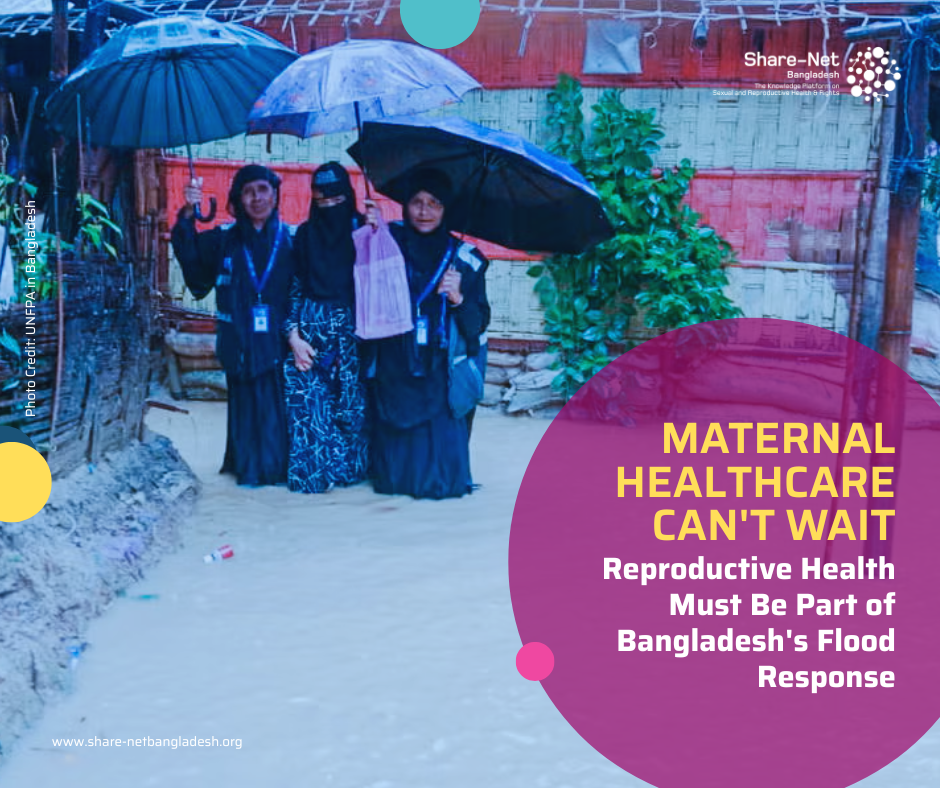
Maternal Healthcare Can’t Wait: Reproductive Health Must Be Part of Bangladesh’s Flood Response
Floods often leave behind visible destruction. Roads disappear, homes collapse, and crops are washed away. Yet one of the least visible consequences unfolds quietly inside overcrowded shelters, damaged health centres, and isolated villages, where pregnant women and adolescent girls struggle to access lifesaving sexual and reproductive healthcare.
Bangladesh’s latest flash floods and landslides have affected nearly one million people. Among them are an estimated 14,000 pregnant women and more than 291,000 women of reproductive age. According to government estimates, thousands have been displaced as floodwaters submerged communities across Sylhet, Mymensingh and Chattogram, disrupting hospitals, maternal health services and transport networks.
The numbers reveal a humanitarian crisis, but they also expose a policy challenge. Emergencies are still largely viewed through the lens of food, shelter and rescue operations, while reproductive healthcare often receives attention only after immediate disasters begin to stabilise.
“Pregnancy and protection needs do not stop in emergencies,” said Catherine Breen-Kamkong, UNFPA Representative in Bangladesh. The statement reflects a growing global understanding that maternal health cannot be separated from disaster preparedness.
Research published by the World Health Organization and UNFPA consistently shows that disasters increase the risks of pregnancy complications, maternal deaths, gender-based violence and mental health challenges. Limited privacy, poor sanitation and overcrowded emergency shelters also increase vulnerability for women and adolescent girls, particularly those who require antenatal care, safe childbirth services and menstrual health support.
The situation is especially urgent in Bandarban, where hundreds of women are expected to give birth this month despite damaged health facilities and disrupted transport. Meanwhile, thousands of Rohingya refugees in Cox’s Bazar continue to face similar risks as humanitarian agencies work to maintain essential maternal healthcare despite flood damage.
Encouragingly, emergency responders have deployed mobile health teams, midwives, dignity kits, menstrual health supplies and psychosocial support across affected areas. These interventions save lives, but experts argue they should become part of permanent climate adaptation strategies rather than emergency responses alone.
The Intergovernmental Panel on Climate Change has repeatedly warned that South Asia will experience more frequent and intense extreme weather events. For Bangladesh, one of the world’s most climate-vulnerable countries, that means health systems must become as resilient as embankments and cyclone shelters.
Climate resilience is no longer only about infrastructure. It is also about ensuring every woman can safely give birth, every adolescent can access reproductive health information, and every emergency shelter protects dignity alongside survival.
Because when disasters strike, reproductive health is not a secondary issue. It becomes a matter of life, equality and human rights.