
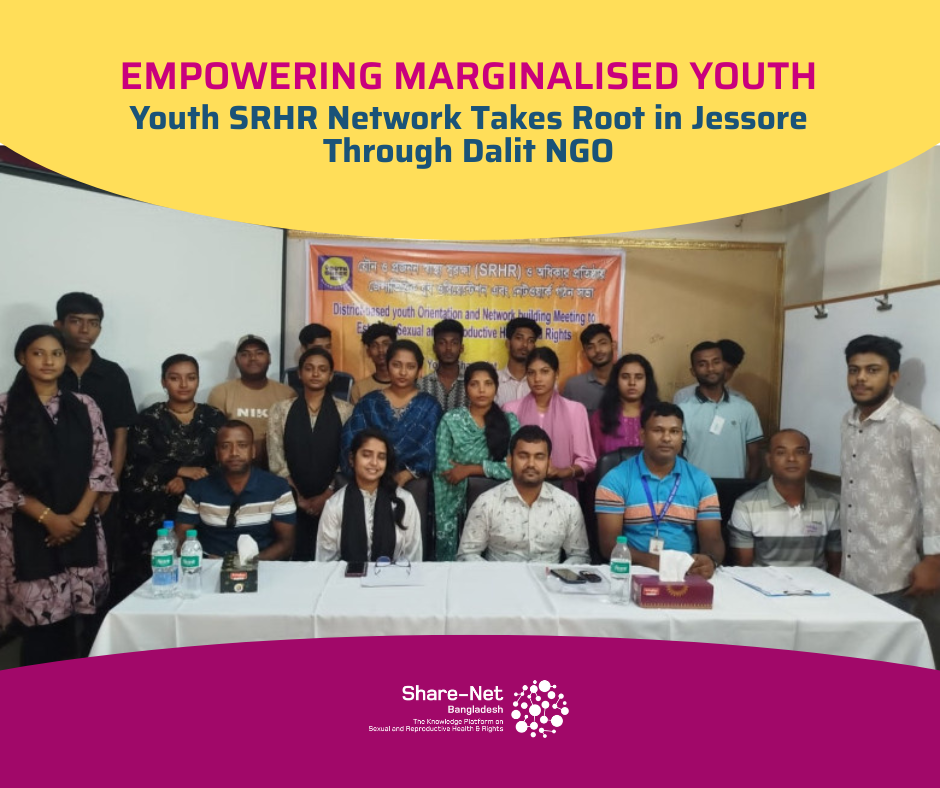
Empowering Marginalised Youth: Youth SRHR Network Takes Root in Jessore Through Dalit NGO
In many parts of Bangladesh, conversations around sexual and reproductive health and rights remain trapped behind social discomfort, stigma, and silence. For marginalised communities, especially Dalit and underrepresented youth, the lack of accurate information often translates into health risks, discrimination, and exclusion from essential services. Against this backdrop, a small but significant gathering in Jessore this week signalled a growing shift in how young people are reclaiming their right to health, dignity, and information.
With the slogan, “Break the silence, build protection, ensure bodily dignity and rights,” a district-level Youth Sexual and Reproductive Health and Rights (SRHR) Network was officially formed during an orientation session organised under the Youth Share-Net project on May 6 at Joyeety Hotel and Restaurant in Jessore.
The initiative, implemented by the development organisation Dalit with support from RedOrange Bangladesh and funding from AmplifyChange, aims to strengthen SRHR awareness among Dalit and marginalised youth while building a sustainable grassroots network capable of community outreach.
Speaking at the event, Abu Sayeed Sarkar, Child Rights Officer at the Department of Women Affairs in Jessore, highlighted how deeply rooted social conservatism continues to affect young people’s access to reproductive health information.
“Due to social conservatism, reproductive health is still treated as a hidden issue in our country. Marginalised youth are especially vulnerable because they often grow up without access to accurate information,” he said.
The programme brought together 20 trained young participants who will now form a district youth team. Organisers said the group will later establish 20 sub-groups at the local level, with the goal of reaching nearly 200 marginalised young people across the Khulna region through peer-led awareness activities.
The approach reflects a growing global recognition that youth-led interventions are often more effective in addressing SRHR barriers among adolescents. According to UNFPA and UNICEF data, Bangladesh continues to face major SRHR challenges, including child marriage, menstrual health stigma, and limited access to comprehensive sexuality education. Nearly 51 percent of Bangladeshi women aged 20-24 were married before the age of 18, while many adolescents still lack reliable SRHR information, particularly in rural and socially excluded communities.
What makes the Jessore initiative notable is its focus on community ownership rather than top-down awareness campaigns. By training young representatives from marginalised backgrounds, the programme seeks to create trusted peer educators capable of challenging myths and encouraging open dialogue within their own communities.
During the orientation, trainers and facilitators stressed that misinformation and harmful taboos continue to fuel fear around reproductive health issues. Participants also discussed the importance of connecting with expert-driven platforms such as Share-Net Bangladesh to access evidence-based SRHR knowledge and advocacy tools.
Beyond awareness, the network signals something more important for Bangladesh’s SRHR movement. It represents a gradual shift from silence to participation, where young people are no longer seen only as beneficiaries, but as organisers, educators, and advocates for change.
For many of the participants, the event was not just a training session. It was an opportunity to claim visibility in conversations that have historically ignored them.
And in a society where silence often shapes public health outcomes, that shift may prove more powerful than statistics alone.