
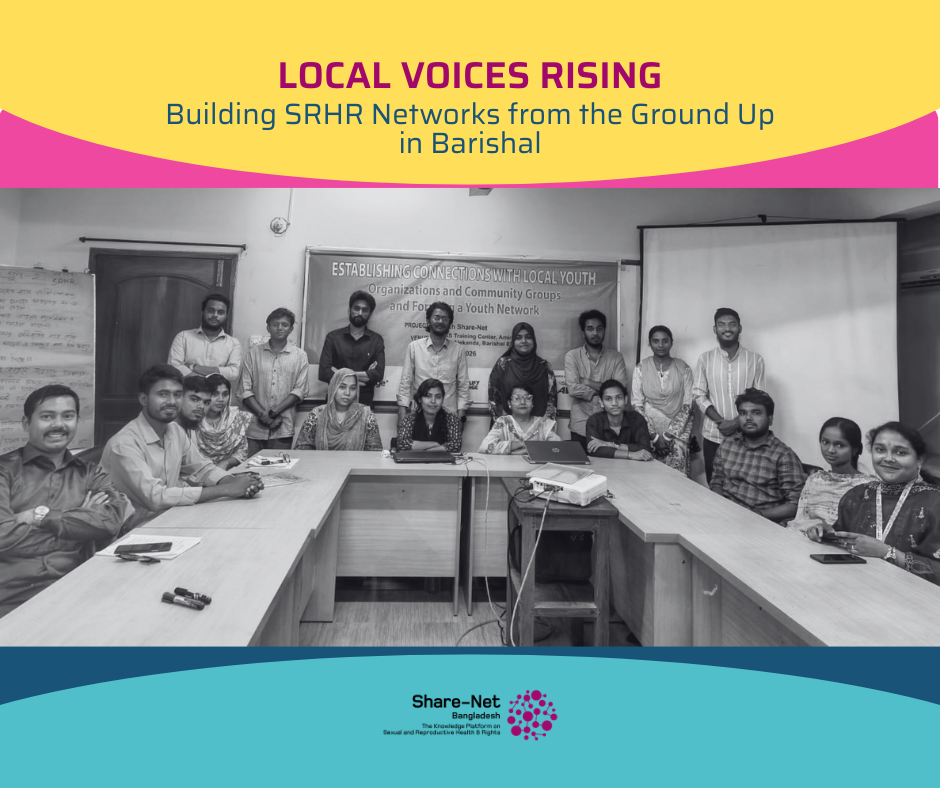
Local Voices Rising: Building SRHR Networks from the Ground Up in Barishal
In a country where nearly one-third of the population is aged between 10 and 24, the question is no longer whether youth voices matter in Sexual and Reproductive Health and Rights (SRHR), but how effectively they are being heard. On April 8, 2026, in Barishal, a quiet but significant step had already been taken toward answering that question.
A meeting titled “Establishing connections with local youth organizations and community groups and forming a youth network” had been convened at the AVAS Training Centre under the Youth Share-Net project. Implemented by the Association of Voluntary Actions for Society (AVAS), initiated by RedOrange, and supported by AmplifyChange, the event had brought together representatives from local youth-led organizations and students from the University of Barishal.
The session had opened with remarks from Umme Saifunnessa Lucky, Director of Finance and Administration at AVAS, setting the tone for a collaborative and youth-centered discussion. Resource person Nasrin Khanam and AVAS Director of Advocacy and Communication Md. Shahidul Islam had then guided the conversation toward practical pathways for building a sustainable youth network focused on SRHR.
At its core, the meeting had been less about formal presentations and more about participation. Through open dialogue, attendees had explored how youth-led initiatives could address persistent gaps in SRHR awareness, especially in semi-urban and rural contexts like Barishal. Participants had emphasized that youth engagement is not just beneficial but essential. As one speaker noted, “Active participation of young people can significantly improve access to health information and build awareness across communities.”
This reflects a broader national challenge. According to recent data from the Bangladesh Demographic and Health Survey, adolescent awareness of comprehensive SRHR information remains uneven, particularly outside major urban centers. Early marriage, limited access to youth-friendly health services, and stigma around reproductive health discussions continue to restrict informed decision-making.
The Barishal meeting had directly addressed these issues by focusing on network-building as a strategic tool. By linking youth organizations with community groups, the initiative had aimed to create a localized ecosystem where information flows more freely, leadership is nurtured, and collective action becomes possible.
One of the key outcomes had been the development of an initial action plan. Mayuri Akter Tumpa, Project Officer of the Youth Share-Net project at AVAS, had worked with participants to outline practical steps for raising SRHR awareness at the community level. This included peer education, community dialogues, and collaborative campaigns.
While the initiative had shown promise, it also highlighted a critical gap. Youth networks often struggle with continuity, funding, and institutional recognition. Without sustained support, even the most engaged groups risk losing momentum.
Still, the Barishal meeting had signaled something important. It had demonstrated that when young people are given space, structure, and support, they are ready to lead. In a country navigating complex SRHR challenges, that readiness may be one of the most valuable resources available.
The real test, however, lies ahead. Whether these conversations translate into sustained action will determine if this emerging network becomes a catalyst for change or just another well-intentioned initiative.