
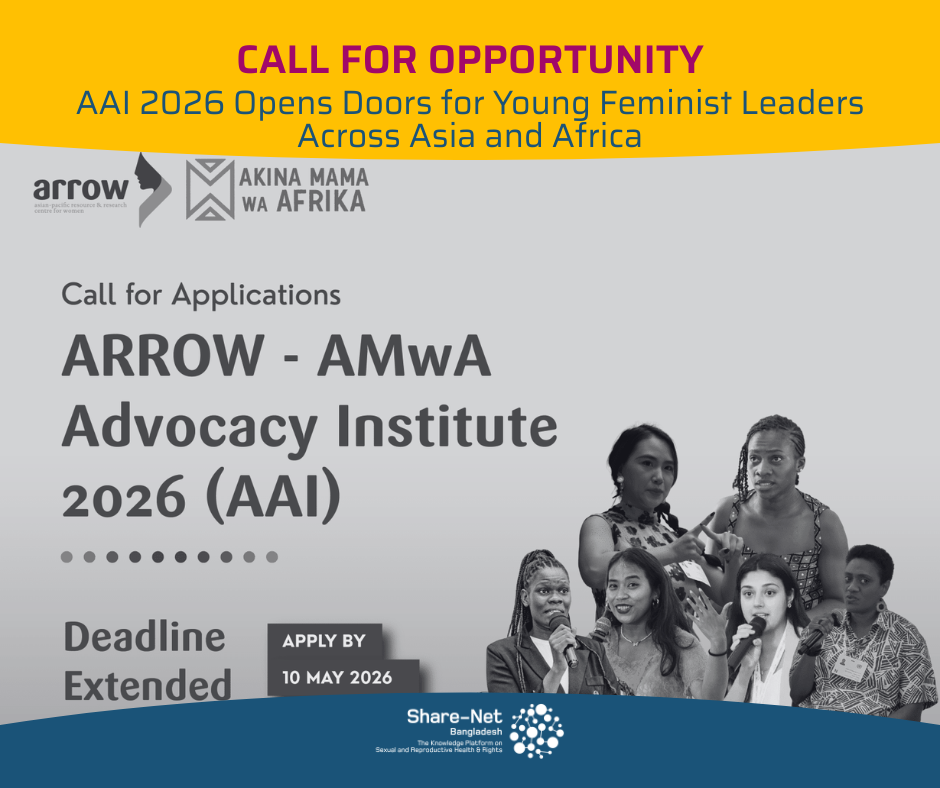
Call for Opportunity: AAI 2026 Opens Doors for Young Feminist Leaders Across Asia and Africa
At a time when sexual and reproductive health and rights (SRHR) are facing renewed global resistance, a new initiative is stepping forward with urgency and intent. The ARROW – AMwA Advocacy Institute 2026 (AAI) is not just another fellowship. It is a strategic response to what many advocates describe as a growing “anti-rights and anti-gender movement” shaping policies and public narratives across regions.
Building on the success of earlier programmes such as the ARROW Advocacy Institute and Women of the South Speak Out Fellowship, this new institute aims to deepen Global South solidarity. Its premise is simple yet powerful. Real change must be driven by those who live the realities.
As the organisers note, the programme seeks “to serve as a platform for and of the next generation feminist leaders from Asia, Pacific and Africa regions.”
Globally, progress on SRHR remains uneven. According to recent UNFPA estimates, nearly 4.3 billion people still lack full access to essential sexual and reproductive health services. Meanwhile, backlash against gender equality policies has intensified in many countries, including parts of South Asia.
In Bangladesh, strides have been made in maternal health and family planning, yet gaps persist in adolescent SRHR education, bodily autonomy, and access to youth-friendly services. Programmes like AAI 2026 are critical because they bridge grassroots activism with policy-level advocacy.
The institute will select 150 young women aged 18–35 from across Asia, Pacific, and Africa. Participants will engage in:
- A seven-week capacity strengthening programme
- Regional caucuses and peer learning spaces
- A competitive pathway into a South2South Feminist Fellowship, where 50 fellows will implement national advocacy plans
The thematic focus reflects the evolving SRHR landscape. Beyond traditional health issues, AAI integrates climate justice, AI, economic justice, and political systems, recognising how these intersect with bodily autonomy and rights.
This interdisciplinary approach is one of the programme’s strongest innovations. It acknowledges that SRHR is no longer confined to clinics or classrooms. It is shaped by digital governance, economic inequality, and geopolitical power shifts.
One of the most notable aspects of AAI 2026 is its emphasis on localisation. Rather than exporting solutions, it centres national and community-level experiences.
Participants are expected to already have at least two years of experience in human rights or SRHR work. This ensures that the programme amplifies existing movements rather than creating parallel ones.
The initiative also promotes intergenerational dialogue, a critical but often overlooked component in feminist organising.
AAI 2026 arrives at a pivotal moment. As democratic spaces shrink in some regions and misinformation spreads rapidly online, young feminist leaders are increasingly at the forefront of resistance and reform.
Yet they often lack sustained funding, technical support, and global platforms. This institute attempts to fill that gap.
Still, questions remain. Can a cohort-based model create long-term systemic change? Will the selected fellows be able to influence policy in restrictive environments? The answers will depend on how effectively this initiative connects advocacy with tangible political outcomes.
This is more than a call for applications. It is a call to rethink how global feminist movements collaborate, adapt, and lead.
With the application deadline set for 10 May 2026, AAI 2026 offers a timely opportunity for young leaders from Bangladesh and beyond to step into spaces where decisions are shaped, not just discussed.
For more details and application procedure, please visit –
Asian-Pacific Resource & Research Centre for Women (ARROW)
