
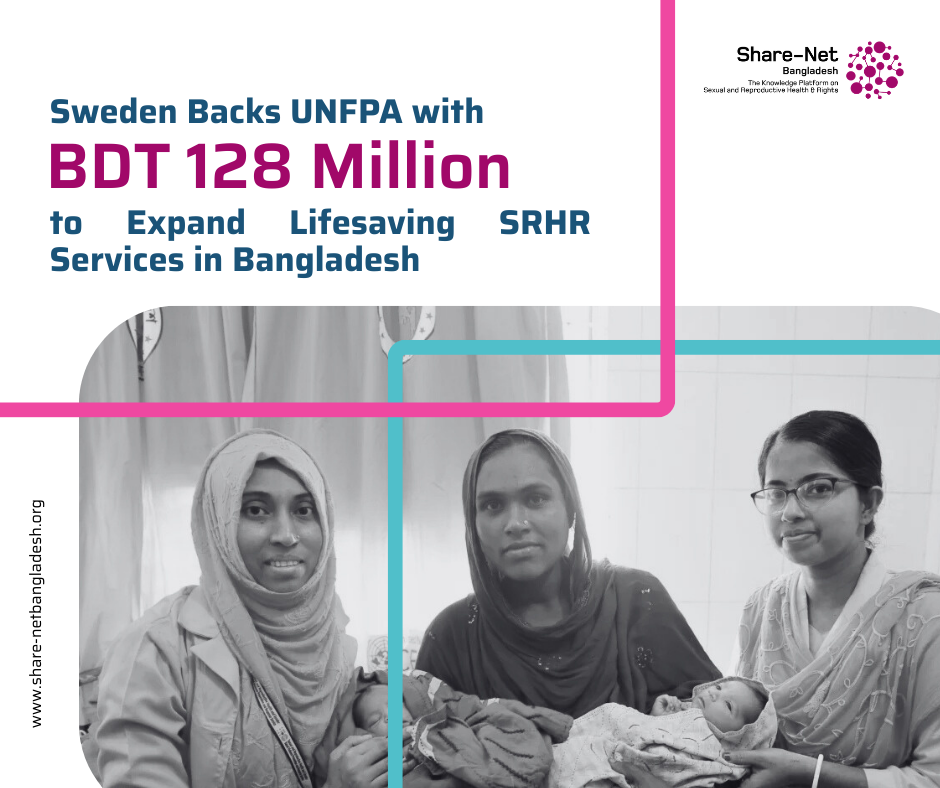
Sweden Backs UNFPA with BDT 128 Million to Expand Lifesaving SRHR Services in Bangladesh
In a country where progress in health policy often hides deep social divides, access to sexual and reproductive health services can still depend on who you are, where you live, and how society sees you. For many vulnerable women and gender-diverse people in Bangladesh, stigma remains a barrier as real as distance or poverty.
Against this backdrop, UNFPA Bangladesh has welcomed a new contribution of 10 million Swedish Krona (approximately Tk128 million) from the Government of Sweden. The funding will strengthen access to integrated, stigma-free, rights-based sexual and reproductive health (SRH) services in selected districts.
Expanding Rights-Based SRHR Services
The initiative aims to expand midwifery-led, community-friendly service models that provide voluntary family planning, HIV and STI testing and treatment, gender-based violence (GBV) response, mental health support, and referral systems. Importantly, the focus is on non-discriminatory, confidential, and survivor-centred care.
“Every person has the right to dignity, safety, and access to quality sexual and reproductive health services,” said Catherine Breen Kamkong, UNFPA Representative in Bangladesh. She noted that the partnership will help reach “some of the most vulnerable and marginalized people… who face multiple barriers in accessing sexual and reproductive health and rights.”
Sweden’s Ambassador to Bangladesh, Nicolas Weeks, echoed this rights-based framing: “No one should be denied care because of who they are or their social status.”
Why This Matters for Bangladesh
Bangladesh has made measurable gains in maternal health and family planning over the past two decades. The maternal mortality ratio has fallen significantly, and contraceptive prevalence has improved. Yet gaps remain. Gender-based violence continues to affect a large proportion of women, and marginalized communities — including gender-diverse individuals — often face discrimination within health systems.
According to national surveys, a significant percentage of women report experiencing intimate partner violence in their lifetime. Meanwhile, stigma and fear of discrimination discourage many gender-diverse people from seeking HIV testing, STI treatment, or reproductive health services. These barriers directly undermine Sexual and Reproductive Health and Rights (SRHR), which include the right to bodily autonomy, informed choice, and access to quality care.
The Swedish-supported programme addresses these challenges by strengthening provider capacity. Midwives, doctors, and paramedics will receive training to ensure respectful, non-judgmental care. The model also emphasizes partnerships with government health institutions, civil society organisations, and community networks — a systems approach rather than isolated service delivery.
Innovation Through Inclusion
The innovation here is not only financial support but the design of integrated care. Instead of treating family planning, GBV response, HIV services, and mental health separately, the initiative brings them under one coordinated, community-anchored model. This approach reflects global best practices in rights-based SRHR programming.
By embedding services within public health systems, the programme also supports Bangladesh’s commitments under the Sustainable Development Goals — particularly SDG 3 (health) and SDG 5 (gender equality).
A Step Toward Equity
This development is a positive signal for the SRHR movement in Bangladesh. It recognises that health equity is not automatic; it requires deliberate investment in those left behind.
In the end, the measure of success will not be the amount of funding announced, but whether a survivor of violence can walk into a clinic without fear, whether a gender-diverse person can seek care without discrimination, and whether reproductive rights are upheld not just in policy — but in practice.
Source: Dhaka Tribune
