
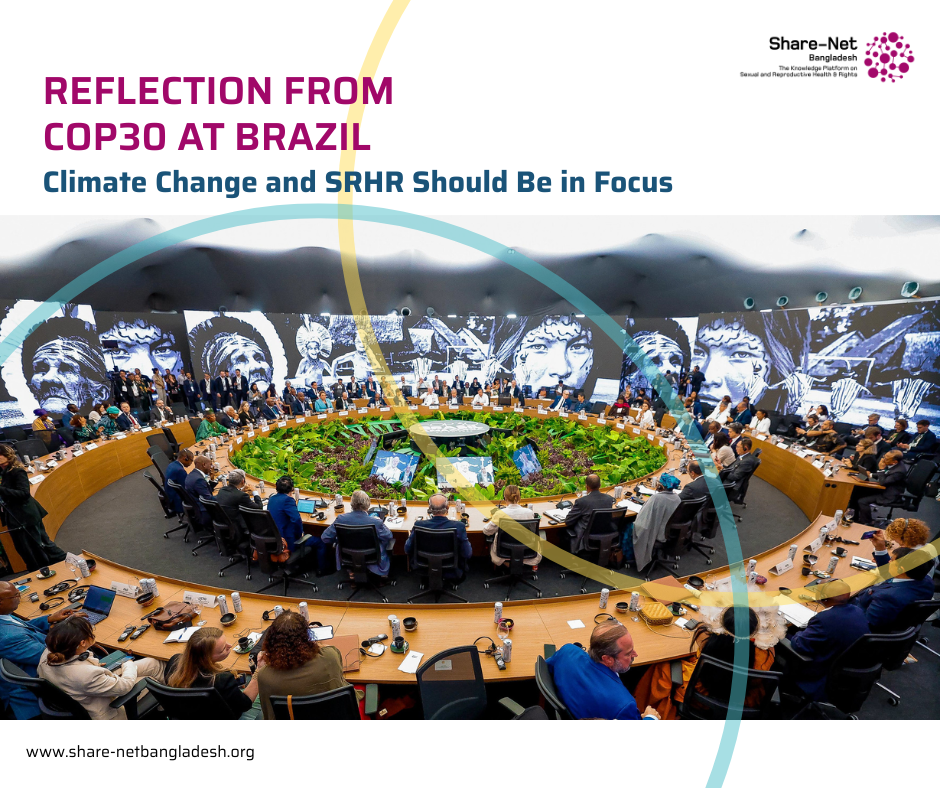
Reflection from COP30 at Brazil: Climate Change and SRHR Should Be in Focus
Global climate conversations often end with powerful declarations, ambitious promises, and carefully negotiated words. Yet, behind the language of climate diplomacy lies a deeper question: who actually benefits from these commitments? As reflections emerge from the recent COP convenings ahead of COP30 in Brazil, experts and activists are urging that climate responses must move beyond rhetoric. One key issue increasingly entering the debate is the connection between climate change and Sexual and Reproductive Health and Rights (SRHR).
At a recent climate adda organised by Power and Participation Research Centre in Bangladesh, participants—ranging from youth climate activists to researchers and policy thinkers—discussed what global climate negotiations mean for vulnerable populations. The conversation revealed both optimism and frustration. As one reflection noted, “a lesson emerging from COP participation is that for advocacy to deliver results, it must be married to strategy.” The same principle applies to SRHR within climate policy: meaningful outcomes require structured planning, funding, and accountability.
Recent global statistics underline why this link matters. According to the United Nations, climate-related disasters have displaced over 32 million people annually in recent years. Women and adolescent girls are among the most vulnerable during such crises, facing disruptions in maternal health services, limited access to contraception, and increased risks of gender-based violence. In climate-vulnerable countries like Bangladesh, these risks are particularly acute.
Yet climate negotiations often overlook SRHR. Discussions remain dominated by emissions targets, financing mechanisms, and energy transitions. The experience of COP28 in Dubai illustrates this gap. While the declaration on “transitioning away from fossil fuels” drew global attention, participants in the PPRC dialogue pointed out that phrases without clear financing or implementation plans risk becoming what one observer described as “diplomatic poetry.” The absence of clear social protection frameworks—including SRHR—further weakens these commitments.
Another challenge raised in the discussion was representation. Bangladesh, despite being one of the world’s most climate-vulnerable countries, often struggles to maintain consistent and specialised negotiators in global forums. Experts warn that issues such as gender equality, reproductive health services during climate disasters, and rights-based adaptation policies frequently lack dedicated advocates in negotiation rooms.
Youth participation also emerged as a major theme. Climate advocacy in Bangladesh has grown rapidly, with students, grassroots activists, and community innovators increasingly shaping the national climate conversation. However, participants stressed that youth inclusion must move beyond symbolism. Instead of simply being invited to discussions, young leaders should help design adaptation programmes, climate financing mechanisms, and community resilience strategies.
Innovation and grassroots solutions offer hope. Bangladesh has already pioneered climate-resilient agriculture, floating farming systems, and community-based adaptation models. Experts believe that linking these initiatives with health systems—including mobile reproductive health services during disasters—could significantly strengthen resilience.
But a major barrier remains: reliable data. Participants warned that inconsistent or manipulated climate data can undermine a country’s credibility in global negotiations. Without strong evidence, advocacy for climate justice—including funding for gender and SRHR-related services—loses its foundation.
Ultimately, the reflection from the climate adda sends a clear message. Climate action must shift from fragmented discussions to integrated solutions that include health, rights, and social protection. As Namira Shameem and Hossain Zillur Rahman of PPRC highlight through their reflections, meaningful progress will require stronger partnerships, transparent governance, and youth-driven innovation.
As the world prepares for COP30 in Brazil, the challenge is no longer just about reducing emissions. It is about ensuring that climate responses protect human dignity and rights. If the next phase of global climate action fails to integrate SRHR, millions of vulnerable women and young people will remain on the frontlines of climate change—without the protection they urgently need.
Source: The Daily Star
Photo Credit: facebook.com