
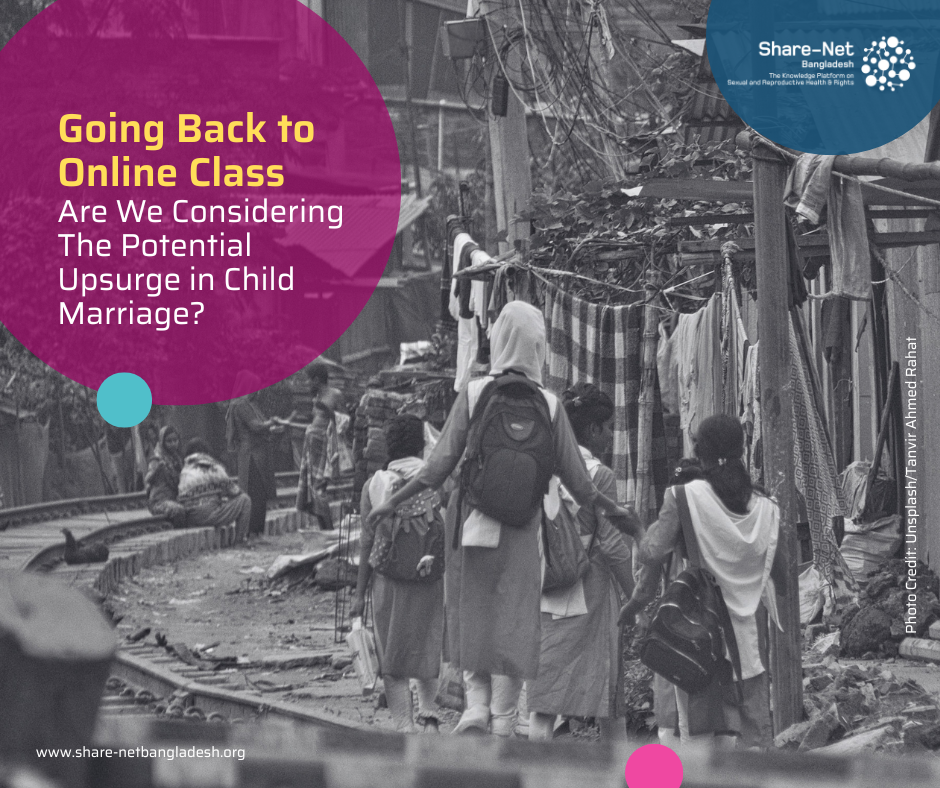
Going Back to Online Class: Are We Considering The Potential Upsurge in Child Marriage?
The debate over bringing back online classes in Bangladesh has returned, not because of a virus this time, but because of a deepening fuel and energy crisis. The government is now actively considering a hybrid education model, with three days of in-person classes and three days online, especially in metropolitan areas. Officials say the move could reduce traffic congestion, save fuel and protect the academic calendar.
But for many child rights and SRHR advocates, the bigger question is not about logistics. It is about what happens when girls are pushed out of the physical classroom again.
Bangladesh’s COVID-19 years already provided a painful answer. Before the pandemic, the country had been slowly reducing child marriage. National prevalence dropped from 66% in 2007 to 59% in 2017, and by 2019, the Multiple Indicator Cluster Survey placed the rate at 51.4% among women aged 20–24. Yet COVID-era school closures, which lasted around 18 months, reversed that momentum dramatically. UNICEF still reports that 51% of girls in Bangladesh are married before 18, the highest rate in South Asia.
The connection between school closures and child marriage is not theoretical, it is evidence-based. During the pandemic, economic hardship, family insecurity and the disappearance of school as a protective space created what researchers described as a “dramatic upsurge.” Girls who were no longer visible to teachers, peers and community monitoring systems became more vulnerable to early marriage, early pregnancy and school dropout. From an SRHR lens, this is devastating: child marriage directly increases risks of adolescent motherhood, maternal health complications, gender-based violence and the long-term loss of bodily autonomy.
That is why the current hybrid proposal presents both innovation and risk. The innovation lies in its attempt to maintain learning continuity while responding to an energy emergency. A three-day online, three-day offline split is far better than total closure. It also acknowledges a lesson learned from COVID: fully digital education can deepen social isolation and inequality.
Yet the risks remain serious, especially for low-income and urban-poor families. Even partial absence from school can weaken the “protective shield” around adolescent girls. In Bangladesh’s SRHR movement, education is not just learning, it is one of the strongest prevention tools against child marriage, early childbirth and gendered violence.
The real test, then, is not whether hybrid classes save fuel. It is whether the government can design the model with child protection safeguards: attendance tracking, adolescent helplines, teacher follow-up, community watch systems and strong referral links to child marriage prevention services.
Bangladesh cannot afford another crisis where girls quietly disappear from classrooms and reappear as brides. The classroom, after all, is often the first line of defence for girls’ rights. If online learning returns, the country’s SRHR ecosystem must move faster than the crisis itself, so that energy savings do not come at the cost of another generation of girls.