
From Screens to Safety: Chittagong Hill Tracts Unite Against Digital Gender Violence
For many girls in the Chittagong Hill Tracts, danger no longer comes only from dark roads or unsafe public spaces. It now glows from a phone screen — in the form of threatening messages, fake social media accounts, and non-consensual image sharing. What was once whispered about in silence is now being named: digital gender-based violence.
This year’s 16 Days of Activism Against Gender-Based Violence, observed globally from 25 November to 10 December, has placed digital violence at the centre of its campaign in Bangladesh’s hill districts. Led under the Ecosystems Restoration Resilient Development in the Chittagong Hill Tracts (ERRD-CHT) Project with support from Global Affairs Canada and the European Union, the initiative is linking online safety with Sexual and Reproductive Health and Rights (SRHR).
Globally, online abuse is one of the fastest-growing forms of gender-based violence. UN studies show women — especially young women and activists — face significantly higher levels of online harassment than men. The World Health Organization reports that one in three women worldwide will experience violence in her lifetime, and increasingly, part of that harm occurs online.
In Bangladesh, rapid internet expansion has widened opportunities — but also risks. Girls often face fake profiles, coercion for photos, cyberbullying and threats of public shaming. In remote regions like Rangamati, Khagrachhari and Bandarban, limited digital literacy and fewer reporting mechanisms deepen vulnerability.
“Our girls are excited to use phones. But they don’t always feel safe,” said one teacher in Rangamati. “They know the danger, even when they cannot name it.”
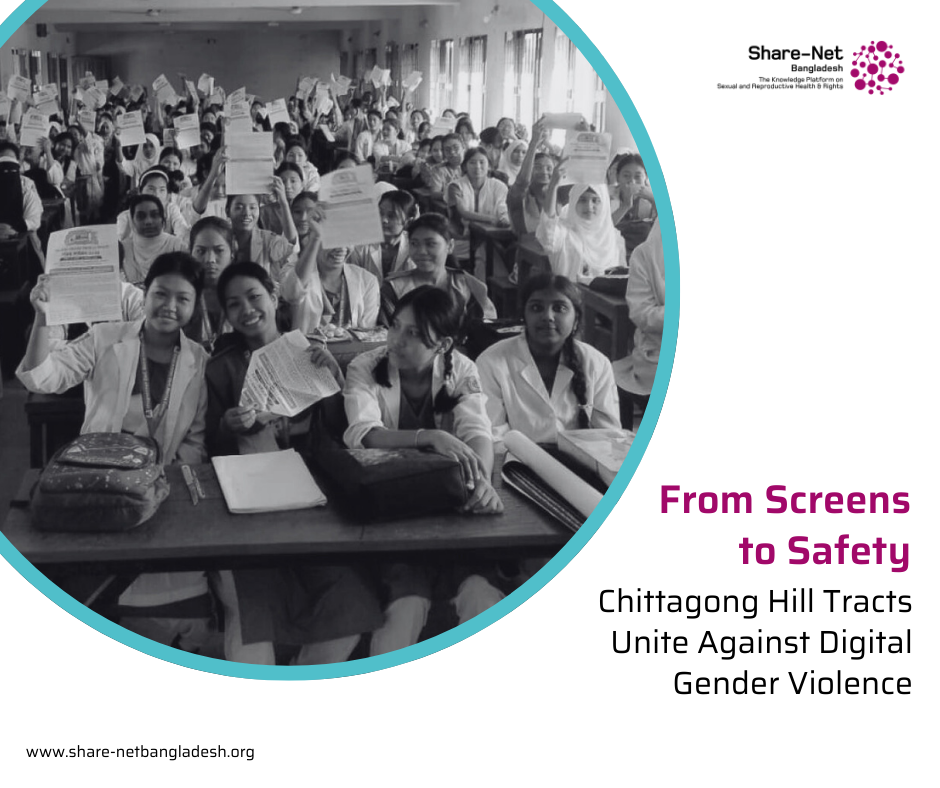
Since launching on 25 November 2025, the campaign has reached 3,959 people — including 2,672 women and girls and 1,287 men and boys. Students from 24 schools and colleges joined rallies, debates, poster competitions and digital safety workshops. Many participants heard the term “digital violence” for the first time.
During a session in Khagrachhari, a college student reflected, “I thought harassment only meant someone touching you. Now I understand that a message can hurt too.”
The campaign also engaged men and fathers. In Bandarban, one parent noted, “We must guide our sons. What they say online matters.”
Local police, reproductive health care workers, volunteer mediators and youth groups have collaborated to raise awareness about reporting systems and victim support centres. This cross-sector approach reflects a growing understanding that digital safety is directly linked to SRHR — including bodily autonomy, mental health, and freedom of expression.
Digital violence restricts women’s access to education, economic participation and leadership. It silences voices and damages confidence. In SRHR terms, it undermines sexual rights and the right to live free from coercion and abuse — whether offline or online.
By integrating digital literacy with community dialogue, the CHT campaign offers a practical model. It does not treat online abuse as separate from gender-based violence but as part of the same continuum.
The movement in the Hill Tracts is still young, but it signals change. By naming digital harm and encouraging open discussion, communities are challenging long-held silence.
Safety today must include the digital world. When girls feel secure online, they can learn, speak and lead without fear. Ending digital gender-based violence is not just a campaign goal — it is a necessary step toward equality, dignity and stronger SRHR protections in Bangladesh.
Source: UN Bangladesh