
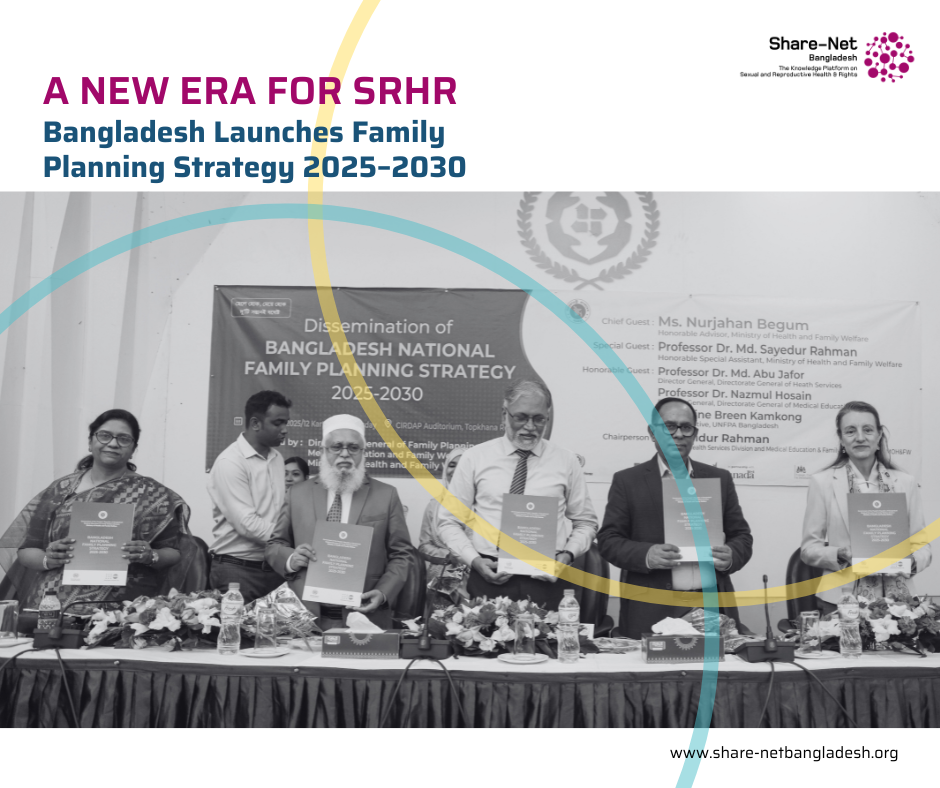
A New Era for SRHR: Bangladesh Launches Family Planning Strategy 2025–2030
In a country where family planning once meant controlling numbers, Bangladesh is now reframing it as a question of rights, dignity and choice. On October 28, 2025, the government launched its National Family Planning Strategy 2025–2030 — a five-year roadmap that signals a decisive shift toward Sexual and Reproductive Health and Rights (SRHR), women’s empowerment and youth inclusion.
Developed with technical support from the United Nations Population Fund (UNFPA), the strategy moves beyond demographic targets and places reproductive rights at the centre of national development.
From Population Control to Rights-Based Planning
Bangladesh has long been hailed as a family planning success story. Modern contraceptive use rose from just 8% in the 1970s to around 64% today. Yet progress has slowed in recent years. An estimated 5 million women still face unmet need for contraception — meaning they want to avoid or delay pregnancy but lack access to modern methods.
The new strategy directly targets these gaps. It focuses on adolescents, addresses early motherhood driven by child marriage, and seeks to reduce over-reliance on short-acting contraceptive methods by expanding access to long-acting reversible contraception.
Officials highlighted the economic case for investment: every USD 1 invested in family planning can save up to USD 14 in health and social costs. They also noted that effective family planning could prevent nearly 30% of maternal deaths and reduce unintended pregnancies by two-thirds.
Bangladesh’s maternal mortality ratio currently stands at around 115 deaths per 100,000 live births, according to recent global estimates. While significantly lower than two decades ago, disparities remain between urban and rural areas, and among poorer households.
Evidence, Implementation and Accountability
At the launch event, Professor Md. Sayedur Rahman, Special Assistant to the Chief Adviser, stressed that success depends on “rigorous local-level implementation guided by fresh evidence and new surveys.” This emphasis on data signals an effort to avoid policy stagnation.
UNFPA Bangladesh Representative Catherine Breen Kamkong described family planning as “a vital tool for breaking the cycle of poverty,” adding that it allows couples “the dignity to decide their own futures.”
The strategy aligns with the global FP2030 commitment, which aims to achieve zero unmet need for family planning and zero preventable maternal deaths by 2030. It also supports the Sustainable Development Goals on health, gender equality and poverty reduction.
Why It Matters for SRHR
Family planning is not only about contraception; it is about sexual rights, reproductive rights and informed choice. Adolescents, particularly girls affected by child marriage, remain at higher risk of early pregnancy, school dropout and health complications. Expanding youth-friendly services could reshape long-term health and economic outcomes.
The strategy’s success, however, will depend on quality of care, trained health workers, community engagement and sustained financing. Past gains show that Bangladesh can deliver results. The next five years will test whether rights-based reproductive healthcare can reach those still left behind.
As Bangladesh steps into this new phase, the question is no longer whether family planning works — but whether it can truly become universal, equitable and grounded in human rights.
Source: RTV Online