
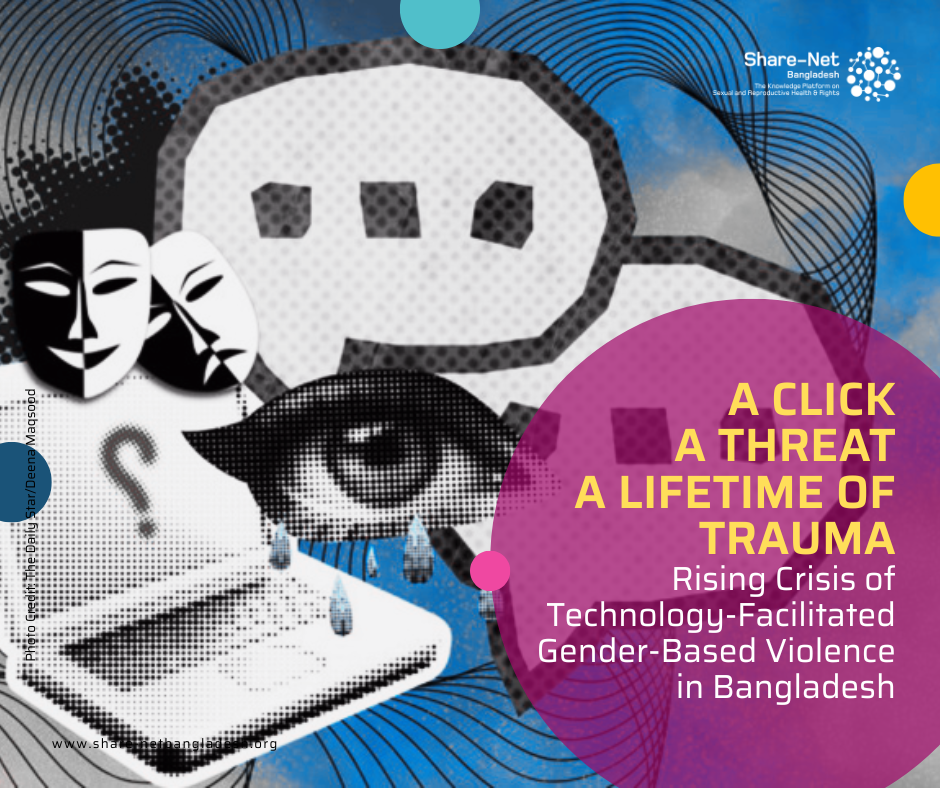
A Click, A Threat, A Lifetime of Trauma: Rising Crisis of Technology-Facilitated Gender-Based Violence in Bangladesh
A smartphone can open doors to education, healthcare, employment, and opportunity. But for many women in Bangladesh, it can also become a gateway to fear. Technology has transformed everyday life, yet it has also created new spaces where violence follows women long after they leave the streets and enter the digital world.
Technology-Facilitated Gender-Based Violence (TFGBV) is no longer an emerging concern. It is becoming a public safety and Sexual and Reproductive Health and Rights (SRHR) issue that affects thousands of women and girls across the country.
A recent case reported in The Daily Star illustrates this reality. A woman from Bagerhat was secretly recorded, blackmailed, and later faced domestic violence after manipulated videos were sent to her husband. While her personal life collapsed, the alleged perpetrator remained beyond accountability. Cases like this reveal how digital abuse can quickly escalate into physical violence, psychological trauma, and social isolation.
The pattern extends beyond one individual. In Sylhet, a female primary school headteacher became the target of widespread online harassment after posting a harmless personal video on social media. The backlash demonstrated how women continue to face intense public scrutiny and moral policing in digital spaces.
Evidence suggests these incidents are part of a much larger trend. According to the Bangladesh Bureau of Statistics (BBS) and UNFPA’s 2024 National Survey on Violence Against Women, more than 8 percent of women who use digital technology have experienced online sexual harassment, blackmail, or image-based abuse during their lifetime. Meanwhile, Bangladesh Police Cyber Support for Women received over 60,000 complaints in 2024, with information leaks, hacked accounts, and blackmail among the most common offences.
“Technology can empower women. But without safety, it can also become another tool of control.”
Experts argue that digital violence should not be viewed only as a cybercrime. It is closely linked to broader SRHR concerns, including gender-based violence, mental health, coercion, reproductive autonomy, and women’s ability to participate safely in education, work, and public life.
Bangladesh has taken legal steps through the Cyber Security Act 2026, introducing stronger provisions against image-based abuse and sextortion. However, legal reforms alone cannot solve the problem. Faster investigations, specialised cyber tribunals, stronger digital literacy, and accessible reporting systems remain equally important.
Digital safety is no longer optional. As Bangladesh moves towards a more connected future, protecting women online is becoming as essential as protecting them offline. Technology should expand freedom, not fear. The country’s digital progress will ultimately be measured not only by internet access, but by whether every woman can use that access safely and with dignity.
